Trademark Status Shows “Opposed” but You Have Not Received a Notice: What Should You Do?
24 November 2026
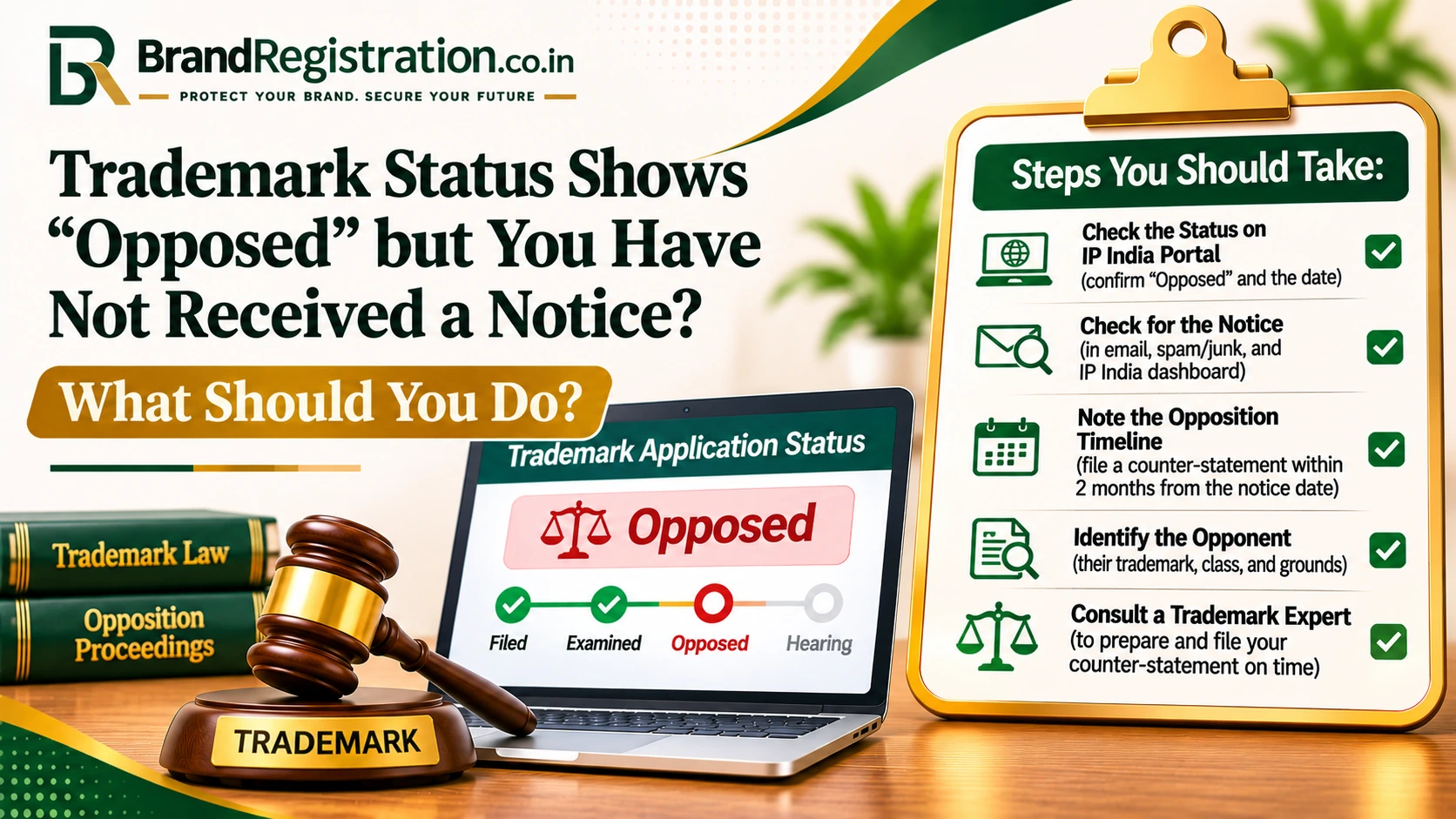
Table of Contents
If your trademark status shows “Opposed” but you have not received a notice, obtain the opposition papers and investigate the service record immediately. Do not assume that an empty inbox means no deadline is running: communications may have gone to a representative or another address on the application.
Start with the application record on IP India, then contact the person who filed for you and, if necessary, the Trade Marks Registry. The immediate goal is to identify the opponent’s grounds, establish what the Registry records about service and prepare an appropriate counter-statement.
1. Trademark opposition notice not received: what does “Opposed” mean?
“Opposed” indicates that an application has encountered a challenge to registration. The notice of opposition should identify the party challenging the application and the grounds on which it objects. Until you see the papers, the status alone cannot tell you the strength of that challenge or what facts you need to answer.
An opposition is a contested proceeding before the Trade Marks Registry. It is possible to defend an application, but the applicant needs to take the procedural steps that apply to the case. A status entry is a reason to act; it is not itself a complete account of the proceedings.
1.1 Opposition and examination are different
An examination objection comes from the Registry’s examination of the application. An opposition is brought by another party against the application. A response to an examination report and a counter-statement in opposition therefore serve different purposes.
A show cause hearing generally gives an applicant an opportunity to address concerns raised about the application. It should not be treated as interchangeable with a hearing in an opposition: read the actual notice to identify the proceeding, the issues and the action requested. If both types of communication appear in your records, keep them separately.
For brand registration, this distinction matters commercially. A business may have invested in a name and logo while registration remains pending. An opposed application is not the same thing as a registration certificate, and a status screen should not be presented internally or to a marketplace as proof that the mark has been registered.
2. Who needs to respond, and what should they establish first?
The applicant named in the challenged application is the party whose position needs to be defended. The applicant may be an individual or a business; a company is not a prerequisite for every trademark application. The relevant question here is who applied for this particular mark and who has authority to act for that applicant.
Identify the applicant named on the application, rather than assuming that the person managing the brand is the applicant.
Establish who currently has authority to instruct a representative and approve the response.
Determine whether an existing agent remains responsible for correspondence or whether that arrangement has ended.
Identify the application and the mark actually under challenge before making a decision about the response.
A company name and a brand name can be different. A company may own an application for a product name that does not resemble its corporate name, while a founder may have applied personally before a business was incorporated. That distinction affects who should make decisions and give instructions; it does not, by itself, determine whether the mark can be defended successfully.
If ownership or authority has changed since filing, avoid treating an internal handover as proof that the Registry’s record has also changed. Identify the discrepancy and obtain advice on the appropriate recordal or authorisation. Until the position is clear, nominate one person to coordinate the response so that instructions are not issued twice or contradicted.
3. Documents to prepare before drafting a response
Some material below is needed to understand the dispute; other material is useful for preparing a defence and any later evidence. This is a practical preparation list, not a claim that every item must accompany the initial counter-statement.
3.1 Application and notice materials
Application details: Keep the application number, applicant name, mark and description of goods or services together. These identify the proceeding and provide the reference against which the opposition should be read.
Complete opposition papers: Obtain the notice and any available attachments, including particulars of earlier rights relied on. A status screenshot can establish what you saw, but it does not explain every allegation.
Correspondence and delivery material: Retain relevant emails, envelopes, portal records and communications from a representative in their original form where possible. They may help establish what was communicated and when.
Application history: Retain the application as filed and material changes or correspondence in the file. These help the person drafting the answer understand the position already taken before the Registry.
3.2 Commercial records and representation
Brand-use records: Collect dated examples of labels, packaging, website pages, advertisements or invoices showing the mark as actually used. Their value depends on the issues raised; a file full of undated artwork is less useful for building a chronology.
Business chronology: Note when the name was selected, when use began and which products or services carried it. Separate launch plans from actual use and identify the source for each date.
Representative information: Keep the engagement details and any existing authorisation accessible. If someone new is to act, ask what authorisation and filing format are appropriate for that representation.
Existing agreements: Preserve any relevant permission, coexistence, assignment or settlement documents. Read their scope and parties carefully rather than assuming an agreement about one use resolves every issue in the application.
Organise electronic copies so that a reviewer can identify the document, date and source without opening dozens of similarly named files. Keep the originals intact. If a record is incomplete or an important date is uncertain, flag that internally rather than filling the gap with an estimate presented as fact.
4. How to check the notice online and start the response
The following sequence separates locating the record, preparing a position and submitting it. Portal labels and available documents can change, so use the application details rather than relying on a search result that happens to contain a similar brand name.
Open the official route. Go to IP India and navigate to the Trade Marks application status or e-services facility. Use the application number to locate the specific record.
Inspect the record and available documents. Review the current status, relevant entries and any opposition-related documents made available against that application. Save a copy of the notice and attachments if the facility offers them, and record the date on which you accessed the page.
Obtain missing material. If no notice is available to download, ask the existing representative for the complete papers and approach the Registry for the opposition details and a copy. Give the application number and identify yourself or your authority to seek information.
Analyse the allegations. Read the notice as a set of separate claims. Identify what the opponent says about its rights, the challenged mark and the goods or services, then decide which statements are admitted, disputed or require investigation.
Prepare the counter-statement. Draft a response for the applicant that addresses the grounds and reflects facts the applicant can support. Use the current official form and filing instructions applicable to the proceeding; do not rely on an old form number appearing in an archived schedule.
Submit through the applicable channel. Use the Trade Marks e-filing facility if filing online, following its current instructions for the chosen proceeding, attachments, authentication and payment. An authorised representative can handle the submission where engaged for that purpose.
Save proof of submission. Retain the final filed version, payment record and acknowledgement together. Review the application record afterwards for the filing and subsequent communications, rather than treating a draft or a payment attempt as the completed submission.
If you can see only a status entry, do not invent the opponent’s case from the name of a competing business or a search result. An effective answer depends on the actual allegations. At the same time, obtaining the papers and investigating service can proceed alongside the collection of background information.
For a trademark opposition notice check online, distinguish a public application-status view from the authenticated filing account used to submit documents. Access to one does not necessarily establish that you have completed an action in the other. Keep a note of which account or representative is responsible for future filings.
5. How to investigate a missing notice and its service
When a trademark opposition notice email is not received, the first issue is where communications were directed. Look beyond the mailbox of the person currently managing the brand. An earlier employee, founder, agent or lawyer may have been responsible for the application when it was filed.
5.1 Build a service chronology
Record the dates on which the status was first noticed, any document was downloaded and any representative reported receiving communications. Preserve the original messages and attachments rather than forwarding only extracts. If physical correspondence is found, retain the envelope and any delivery information with the document.
Compare those records with the contact and representation details appearing in the application file. An address or email that is no longer monitored can explain why a business did not see a communication. It does not, on its own, resolve the legal question of whether service was effective.
Keep two separate columns in your chronology: “what we received or found” and “what the Registry record says.” This makes a gap visible without turning an assumption about non-receipt into an asserted fact.
5.2 Request the Registry’s record
When making an enquiry, ask for the notice and the available particulars of its communication or service. Identify the application and opposition, explain that the applicant has not located the notice, and request the relevant record rather than asking only for a verbal assurance that there is no deadline.
Keep a copy of the enquiry and the response. If the record appears to show service that the business disputes, preserve both versions of the facts and seek case-specific advice promptly. Whether a notice was served, and the effect of any defect, depends on the applicable law and the evidence; an unserved-notice claim should not be assumed to succeed merely because no email reached a particular inbox.
6. What determines the counter-statement timeline?
The statutory framework for opposing an application and filing a counter-statement is in Section 21 of the Trade Marks Act, 1999, with procedural rules governing the proceedings. The date to use for a particular deadline must be assessed against that framework and the evidence of communication or service in the case.
6.1 Separate the relevant dates
The date the opponent filed its opposition, the date shown on a notice, the date of a Registry communication and the date you discovered the status can be different. Do not choose whichever date gives the business the most time. Record each date with its source and identify which one matters under the applicable rule.
The supplied official fee-page extract does not set out the counter-statement deadline. Obtain the current statutory text and an assessment of the service record before calculating the due date; do not use the date of a portal search as a substitute for that assessment.
6.2 Allow time for preparation
Set an internal working date earlier than the assessed legal deadline. Time may be needed to obtain the complete notice, reconcile instructions from the business and its representative, draft the answer, arrange authorisation and complete the filing. A late discovery leaves less room for disagreement over facts or technical problems.
A missed response deadline can put the application at serious risk. An unanswered question about service is a reason to investigate urgently, not a reason to leave the application unattended.
The overall duration of opposition proceedings is separate from the time allowed for the first response. Later evidence, communications, hearing arrangements and the Registrar’s decision can affect the duration. No fixed completion date should be promised from the status label alone.
7. Government fees and the full cost of a defence
Use IP India’s Forms and Official Fees page to find the current schedule and form applicable to the action being taken. The page also contains older material, so match the entry to the current rules and the precise filing rather than selecting a fee merely because it mentions opposition.
Government filing charge: Identify the charge, if applicable, for the applicant’s response and the selected filing mode. Do not substitute the amount payable by the opponent for a different action.
Professional preparation: Ask whether the quotation covers reviewing the notice, drafting the counter-statement and completing submission, or only one of those tasks.
Later proceedings: Ask how evidence preparation, communications, hearings and settlement work are priced. The first response is not necessarily the full cost of defending the application.
Internal and commercial costs: Budget for staff time and, if a change becomes necessary, changes to packaging, domains, marketplace listings, signage and customer communications.
The official page includes the First Schedule under the Trade Marks Rules, 2017 and an older schedule. The available extract does not establish the current fee for the applicant’s counter-statement, so no amount is assumed here. The same care applies when searching for trademark opposition Form TM-O: use the current official instructions for the particular action, rather than an old form reference copied from a search result.
When comparing service quotes, ask for a written scope and identify whether government charges are included or passed on separately. A low initial drafting quote may be appropriate for a limited task, but it should not be mistaken for the price of representation throughout the dispute.
8. What happens after the counter-statement?
8.1 Evidence and hearing
Opposition proceedings can continue after the initial answer. The parties may have opportunities to put forward evidence, and a hearing and decision may follow. The documents and directions issued in the particular case determine what needs attention next.
Keep a single matter file containing the submitted response, acknowledgement, subsequent notices, instructions and correspondence. Assign responsibility for monitoring it to a named person and give that person access to the relevant representative. If responsibility changes, make the handover explicit instead of assuming that a shared inbox will be watched.
Evidence should support the position actually advanced. For example, if a claim depends on use at a particular time, the reviewer needs to understand what the dated records show and where any gaps lie. Preserve records in their original form so that the basis of the evidence can be traced.
8.2 Keep the application commercially usable
Tell the people responsible for marketing and sales that the application is contested and that its outcome is unresolved. They can continue making business decisions with an accurate picture of the risk, rather than assuming that a pending application provides a guaranteed registration.
If settlement is considered, involve the people who control the mark and the products. A restriction that looks narrow in a legal draft may affect a planned product line, a sales channel or an existing label. Record the business consequences before authorising terms, and do not assume that negotiations automatically suspend a procedural obligation.
9. Mistakes that weaken an opposition response
Replying to the wrong proceeding. A response drafted for an examination objection may not address an opponent’s allegations. Identify the document and proceeding first; if a draft was prepared for the wrong issue, replace it with a response directed to the actual notice.
Adopting a template without checking the facts. A standard denial can omit a material allegation or include claims the applicant cannot support. Review each substantive statement against the application history and the business’s records before approval.
Confusing a business name with the applied-for mark. The commercial name used on a website may differ from the mark in the application. Frame the response around the application under challenge, while describing actual use accurately.
Treating a payment attempt as a filed response. A transaction screen or an unsent draft is not the same thing as an acknowledgement of submission. Preserve the completed filing record and investigate any failure shown during submission.
Assuming settlement discussions dispose of the case. A conversation or commercial proposal is not a final resolution. Continue to manage the proceeding unless the position has been formally resolved through the appropriate steps.
Giving inconsistent instructions. A founder, marketing team and representative may each describe the launch differently. Reconcile the account internally and identify uncertainties before making factual assertions on the applicant’s behalf.
Another costly error is deciding to defend solely because money has already been spent on the application. Compare the mark’s future value with the strength of the dispute, the cost of a defence and the business disruption of changing it. That decision should be made with the actual opposition papers, not a status label alone.
10. Your next three decisions
Secure the record today: locate the application, obtain the opposition papers and preserve the available communications.
Establish the response plan: identify the responsible applicant and representative, investigate service and assess the applicable deadline. Escalate immediately if the papers are missing, the service record is disputed or the available time is unclear.
Choose how to proceed: if the facts and procedure are manageable, prepare and submit the response through the appropriate official channel. If ownership, prior rights, service or settlement is contested, consider specialist assistance before committing to a position.
Begin the process online via the official government portal, or engage Brand Registration for end-to-end assistance
Frequently Asked Questions
Does an opposed status mean my trademark has been refused?
No. Opposed indicates a challenge to the application; the status alone does not establish the final outcome. Obtain the opposition papers and address the proceeding promptly.
Can the opposition notice be available online even if I did not receive an email?
It may be available in the application record. Search the official IP India status facility using the application number and inspect the available documents. If the notice is not there, ask the representative and the Registry for a copy.
Does the opposition filing date prove when the notice was served?
No. The opponent's filing date and the date of communication or service can differ. Preserve the relevant records and assess the applicable deadline against the law and the facts of the case.
What if my former trademark agent received the notice?
Ask the former agent for the complete papers, correspondence and available delivery information. Whether communication to a representative amounts to effective service requires assessment of the representation and the applicable law.
Can I draft a counter-statement without knowing the opponent's grounds?
You can collect background records, but a meaningful response requires the actual allegations. Obtain the complete notice and attachments as urgently as possible.
Where can I find the government fee for the response?
Use IP India's Forms and Official Fees page and identify the current entry for the specific action and filing mode. The page also contains older schedules, so do not assume an archived fee or form applies.
Can a company name and its brand name be different?
Yes. A company can use a brand name different from its corporate name. For an opposition response, identify the applicant named in the specific trademark application and who has authority to act for it.
Is a show cause hearing the same as an opposition?
No. A show cause hearing generally concerns an opportunity to address issues raised about an application, while an opposition is a challenge by another party. Read the notice to identify the proceeding and required action.