Trademark Objection Reply Filed but Status Still Shows “Objected”? What to Do
24 November 2026
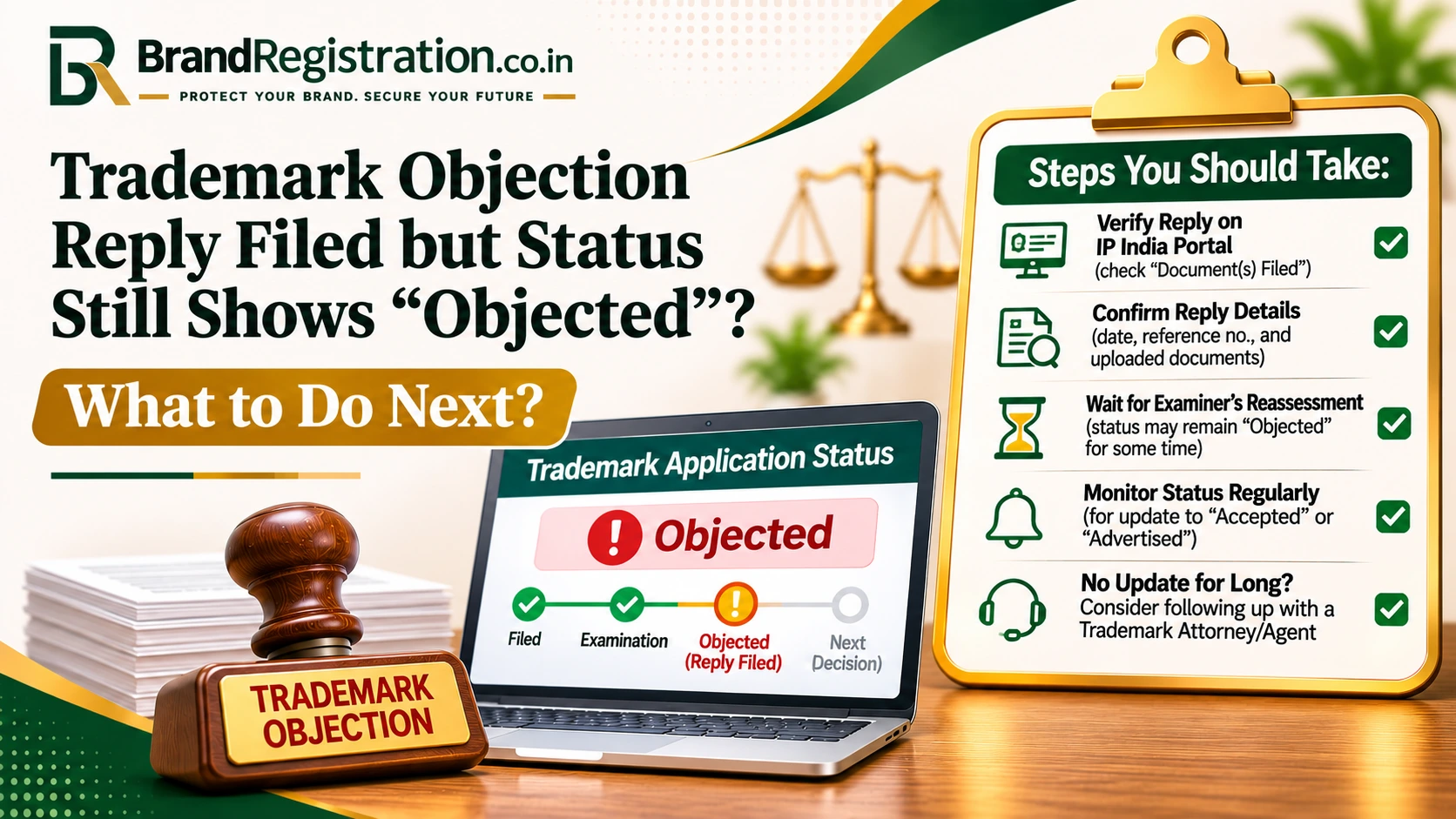
Table of Contents
If your trademark status is objected after reply filed, the label alone does not establish that your reply failed or was rejected. Match your filing acknowledgement to the application and examination report, then review the IP India record for a hearing notice, order or other later communication.
An objection is a question about whether the application can proceed; it is not, by itself, a final refusal. Your next move depends on the evidence: a reply with proof of submission calls for a different response from a reply that exists only as a draft.
1. Why trademark status is objected after reply filed
The Trade Marks Registry examines an application before it can proceed towards registration. An examination report may raise objections to the mark, identify earlier marks or ask the applicant to address an issue in the application. The applicant can respond to the issues raised; the Registry then considers the matter under the examination procedure.
Sections 9 and 11 of the Trade Marks Act, 1999 concern, respectively, absolute and relative grounds for refusal. A Section 9 objection may concern whether the mark can distinguish the applicant’s goods or services. A Section 11 objection may concern a conflict with an earlier mark. Read the report itself to see which grounds apply rather than assuming every objection is about a competing brand.
1.1 A status is not the whole file
A short status label does not tell you everything about a response. For a trademark status still objected, the public record, your acknowledgement and any subsequent notice each answer a different question. The acknowledgement is evidence of a submission; the report identifies what needed an answer; a later notice or order may show what the Registry did next.
An unchanged label is therefore neither proof that the reply was lost nor proof that the Registry has accepted it. It also does not establish that a hearing has been scheduled. Look for a dated communication before drawing a conclusion about the application’s outcome.
1.2 Who should review the record
This review is useful for a brand owner who filed directly, a business whose employee handled the filing, or an applicant represented by an agent or lawyer. It also matters when the person who originally managed the file has left the business: a handover should include the application number, correspondence and access to the relevant filing records.
If you manage several marks, treat each application separately. A reply for a logo in one class should not be assumed to cover a word mark or another application merely because the same business owns both. The application number is the anchor for the review.
2. Documents to assemble before taking action
Start with the records that establish what was requested, what was sent and what happened afterwards. You do not need to recreate the entire history of your brand before you can check the position.
Application details: the application number, mark, applicant name and goods or services covered.
Examination report: the report being answered, including its objections and any cited marks.
Filed reply: the final version submitted, including its attachments, rather than an earlier working draft.
Filing evidence: the trademark objection reply acknowledgement or submission record, with its date and identifying details.
Later communications: any hearing notice, order or Registry correspondence available to you or your representative.
2.1 Match the reply to the examination report
Read the application number and applicant details on the reply against the original application. Then compare the report’s objections with the response and its supporting documents. A complete response should be identifiable as the document intended for that particular examination report, not simply a general note about the business.
If the reply refers to attachments, retain the versions actually submitted. For instance, an argument about a cited mark is harder to assess later if the record available to the business contains only the covering letter and not the material referenced in it. Preserve the files in a format that can be opened and read.
2.2 Ask your representative for the complete record
A message saying “reply filed” is useful information, but it is not a substitute for the acknowledgement and final reply. Ask for both if you do not already have them. Where a representative submitted the response, also ask whether any later communication has been received and whether they remain responsible for monitoring the application.
These records help you assess the trademark examination report reply status without relying on memory or an informal update. Keep the original correspondence as well as a copy stored with the application records; dates and submission references may matter if you need to explain a discrepancy.
3. Step-by-step: review the IP India record
Use the Trade Marks e-Register or e-status service available through IP India. Portal screens and access requirements can change, so follow the prompts presented for the application search rather than relying on a remembered screen layout.
Find the application: enter the application number and complete the portal’s displayed access or security steps. Check the mark and applicant details before proceeding.
Record the current label: note the status and the date on which you checked it. A dated record is more useful than a screenshot with no context.
Read the examination report: open the report available for the application and identify the objections it raises. Check that it is the report addressed in your reply.
Look for the submitted response: review the available documents or history for the reply and its attachments. Compare any visible filing details with your acknowledgement.
Look for later Registry action: inspect available communications for a notice, hearing information or order. Note the dates and read the actual documents rather than relying only on the label.
Choose an action based on the record: continue monitoring if the evidence supports a pending review; investigate a mismatch or respond to a new notice where the record calls for it.
If an expected document is unavailable, record exactly what you could and could not see. The absence of a document from the view you accessed does not, on its own, prove that no document was submitted. Equally, possession of a draft does not prove that the Registry received it.
For a trademark examination reply not updated in the view you checked, compare the acknowledgement with the representative’s filing record before deciding what to do. If the trademark objection reply filed status remains unchanged, save the relevant documents and note whether the latest dated item is your submission or a subsequent Registry communication.
4. Decide what the evidence actually shows
A useful review separates filing evidence from an outcome. The table below sets out common patterns; it does not treat a particular status label as a guarantee of what the Registry has done internally.
What you have found | What it supports | Next action |
|---|---|---|
Acknowledgement matches the application; no later decision is available | There is evidence of a submission, but no documented outcome in the material reviewed. | Keep monitoring and consider a focused enquiry if the wait warrants one. |
Reply draft exists, but no submission evidence is available | The business cannot yet establish from its records that the reply was filed. | Obtain the filing record promptly and assess any response deadline. |
Acknowledgement identifies a different application | The record does not establish a submission against the application being checked. | Investigate the filing immediately and assess the position for the correct application. |
A later notice or order is available | The Registry has taken a documented step, regardless of the short label. | Read and act on the document according to its terms. |
4.1 Where the acknowledgement and record differ
Describe the discrepancy narrowly. “My acknowledgement identifies this application and this submission date, but I cannot see the reply in the documents available to me” is more useful than saying the Registry has lost the file. It tells the person reviewing the issue what evidence exists and what needs investigation.
Until there is a documented decision, phrases such as “trademark objection reply pending”, “trademark reply under review” or “trademark objection reply under consideration” can be useful descriptions of the applicant’s understanding. They should not be treated as proof of an official processing stage unless the Registry’s communication actually says so.
For a portfolio with similar names or logos, keep a separate folder for each application number. This small administrative step makes it easier to spot a reply or notice attached to the wrong file before an enquiry is sent.
5. How to follow up without creating a second problem
When the trademark reply was filed but no response is available, a follow-up should ask a specific question that the existing record cannot answer. Use the contact or enquiry route provided by IP India for the relevant matter, or ask the representative responsible for the application to make the enquiry. A status request is not itself a reply to an examination report or a response to a hearing notice.
5.1 Prepare a targeted enquiry
Identify the applicant and application number, the examination report being answered, and the submission date and reference shown on the acknowledgement. State the current label, describe the discrepancy or delay, and ask whether any further action or communication is required. Include supporting material through the channel’s permitted method rather than sending an unexplained bundle of files.
Keep the request factual. If the concern is that the reply cannot be located, ask about that issue; if a hearing notice has been issued but its details are unclear, identify the notice and ask about the missing information. A focused trademark objection follow up with IP India is easier to assess than a broad demand for immediate registration.
5.2 Keep a record of the response
Save the enquiry, any reference number and the answer received. If a representative follows up, ask for a copy of the written exchange or a clear record of what was communicated. Record who is responsible for the next review so that the application does not fall between the business and its adviser.
An informal response may help explain the position, but it should be read alongside the official application record and any formal notice or order. If a communication identifies a required filing or appearance, deal with that requirement separately; do not assume the enquiry itself satisfies it.
6. How long might the application remain objected?
There are two different clocks: the period allowed for the applicant to respond to an examination report, and the time the Registry takes to consider the matter after a response. A processing estimate for the second does not extend the first. Read the report and applicable rules when assessing a response that may not have been filed.
The supplied official material does not establish a dependable period within which every reply must be reviewed. A trademark registry objection reply delay cannot therefore be converted into a reliable hearing date or acceptance date. Workload, the issues raised and further action on the file may affect what happens next, but the label alone does not reveal the reason for a particular wait.
For a trademark status objected for months, create a monitoring record rather than repeatedly searching without recording the result. Note the last check, the most recent dated document, any enquiry made and who owns the next action. Review incoming correspondence as well as the public record: a new notice can require action even if a summary view has not yet been reviewed by the business.
Do not treat elapsed time as automatic acceptance, refusal or abandonment. If there is no reliable evidence of submission, address that uncertainty promptly; waiting for an expected status change does not establish that the original response requirement was met.
7. Government fees and professional costs
Rule 10 of the Trade Marks Rules, 2017 points to the First Schedule for prescribed fees. It also provides that, where a fee is payable for filing a document, filing without the fee or with an insufficient fee means the document is deemed not filed for the purposes of proceedings under the rules. Whether a charge applies depends on the particular filing or request, not simply on the fact that the status remains Objected.
Status review: distinguish the act of inspecting a record from any separate filing you may decide to make.
Government charge: identify the exact request or document before using the applicable fee schedule.
Representative’s charge: ask whether review, correspondence and hearing preparation are included in the quoted professional fee.
Later action: a new request or proceeding may have its own requirements; it is not automatically covered by an earlier payment.
Before authorising additional work, request a written breakdown of the task, any government charge and the professional fee. In particular, ask whether the proposed work is an enquiry, preparation for a hearing or a formal filing. Those are different services, and a quote for one should not be assumed to include the others.
The evidence supplied for this article does not establish a precise charge for each possible follow-up or response. Avoid budgeting from an unrelated trademark application fee: the correct question is what action is being taken and whether the applicable schedule prescribes a fee for it.
8. What happens if a show-cause hearing is scheduled?
A show-cause hearing gives the applicant an opportunity to address the Registry’s concerns before the matter is decided. A trademark hearing after an objection reply is not established merely because the status says Objected; look for the actual hearing communication and its instructions. The notice is the working document for the appearance.
8.1 Prepare around the actual objections
Bring the examination report and the filed reply into one working set. Identify each issue raised, the answer already submitted and the supporting material on which the applicant relies. If the report cites earlier marks, organise the relevant details so the applicant or representative can address the comparison without searching through unrelated files during the hearing.
Preparation should be consistent with the application. Check that the name, mark, goods or services and factual claims used in the presentation match the records. If a representative will appear, agree who will provide instructions and who will receive the outcome; the brand owner should understand the position being presented on its behalf.
8.2 Respond to the notice, not an assumed hearing
Read the notice for the date, mode, place or access instructions, and any specific directions. If an issue prevents attendance or compliance, address it through the applicable procedure rather than simply missing the event. Keep a copy of the notice and any communication about it with the application file.
A phrase such as “trademark show cause hearing pending” should reflect an actual notice or reliable communication, not a guess based on an unchanged status. After the hearing, look for the Registry’s subsequent communication or order. The fact that a hearing occurred does not itself establish acceptance.
9. Avoid mistakes that weaken your position
Submitting a duplicate reply without a reason: a second submission can create uncertainty about which version the applicant relies on. Establish the first filing’s position and the purpose of any further filing before acting.
Assuming a draft is a filed response: internal approval, an email attachment or a payment request is not the same thing as a submission acknowledgement. Obtain evidence of what was actually sent.
Mixing application numbers: similar marks and multiple classes make it easy to attach a document to the wrong record. Compare the full identifying details, not just the brand name.
Making unsupported claims: a correction or additional submission should not assert facts the business cannot support. Preserve the documents underlying any claim made in the original reply.
Ignoring the address for communication: an old employee or former representative may still hold important correspondence. Arrange a handover and identify who is monitoring incoming notices.
Treating the label as a decision: a refusal, hearing direction or acceptance should be assessed from the relevant Registry record. Do not base a commercial decision solely on an abbreviated status.
If you discover that the reply was sent against the wrong application or cannot establish that it was sent at all, treat that as a time-sensitive filing issue. The appropriate response depends on the report, the dates and the record; do not assume that a fresh upload automatically cures the problem.
10. Protect the application after the objection stage
10.1 If the application moves towards publication
A trademark accepted after an objection reply has crossed an examination issue, but acceptance is not the same as completed registration. Continue to watch the application for publication and any later proceedings or communications. If another party challenges the application, the relevant notice and procedure require their own response; the examination reply does not answer an opposition automatically.
Keep monitoring ownership and contact details throughout the application’s life. If responsibility for the brand changes inside the business, transfer the record and monitoring task as part of that handover. After registration, retain the certificate and maintain a renewal and portfolio-monitoring system appropriate to the mark.
Use of the registered trademark symbol should reflect actual registration, not merely a pending application or acceptance at examination. An application also does not guarantee an unrestricted right to use a brand where another party may have competing rights.
10.2 Using and registering a business name
A company name and a brand name can be different. Company incorporation and trademark protection serve different purposes, so a business should identify the name or logo it actually wants to protect and the goods or services for which it uses or intends to use it.
For someone asking how to trademark a business name, the starting point is to assess the proposed mark and relevant goods or services, search for potential conflicts and apply through the IP India trademark system using Form TM-A. The Registry examines the application; filing does not itself guarantee registration. If the business is already at the objection stage, the current application and its report should be addressed before assuming a new application is the answer.
Brand Registration’s Trademark Registration service is relevant where a business needs support with protecting a name or logo. Keep the pending application’s documents available so any discussion can distinguish the existing filing from a possible new one.
11. Choose your next step
Use the record to choose one of these paths. Assign a person and a date for the next action so the decision does not end with another unrecorded status check.
Reply acknowledged, no later action found: retain the evidence, monitor the application and make a specific enquiry if needed.
No acknowledgement or wrong application number: establish what happened promptly and assess the response position against the report and applicable rules.
Notice or order found: read its terms, identify the required action and arrange the appropriate response or appearance.
Application accepted or published: continue monitoring for later communications and proceedings rather than treating examination acceptance as registration.
Your strongest next step is the one supported by the application record: prove the submission, identify the latest Registry action and respond to the issue that remains open.
Take the next step with Brand Registration or the relevant government portal
Frequently Asked Questions
Does Objected after a reply mean the reply was rejected?
No. The label alone does not establish rejection. Check the acknowledgement, application record and any later Registry notice or order to determine what has happened.
How can I establish whether my trademark objection reply was filed?
Obtain the submission acknowledgement and final reply, including attachments. Match their application number and identifying details to the application and examination report.
What if I have an acknowledgement but cannot see the reply in the public record?
Keep the acknowledgement and identify precisely what is missing from the view you accessed. Ask your representative to review the filing record or make a focused enquiry through the relevant IP India channel.
What is a show-cause hearing in a trademark application?
It is an opportunity for the applicant to address the Registry’s concerns before the matter is decided. Read the hearing notice for the issues and instructions; an Objected label alone does not establish that a hearing has been scheduled.
Should I submit the same objection reply again to change the status?
Do not assume a duplicate will resolve the issue. First establish whether the original response was submitted against the correct application and identify the purpose of any further filing.
Is there a guaranteed time for the Registry to decide an objection reply?
The official material supplied does not establish a dependable review period for every reply. Monitor the application and correspondence, and distinguish review time from any deadline for the applicant to respond.
Does acceptance after examination mean my trademark is registered?
No. Acceptance at examination is not completed registration. Continue monitoring the application for publication, any challenge and further Registry communications.
Can a company name and brand name be different?
Yes. A company can use a different brand name, but incorporation and trademark protection serve different purposes. Identify the name or logo to protect and the relevant goods or services when considering a trademark application.