Trademark Refused After Hearing? What Should You Check Before Taking the Next Step?
24 November 2026
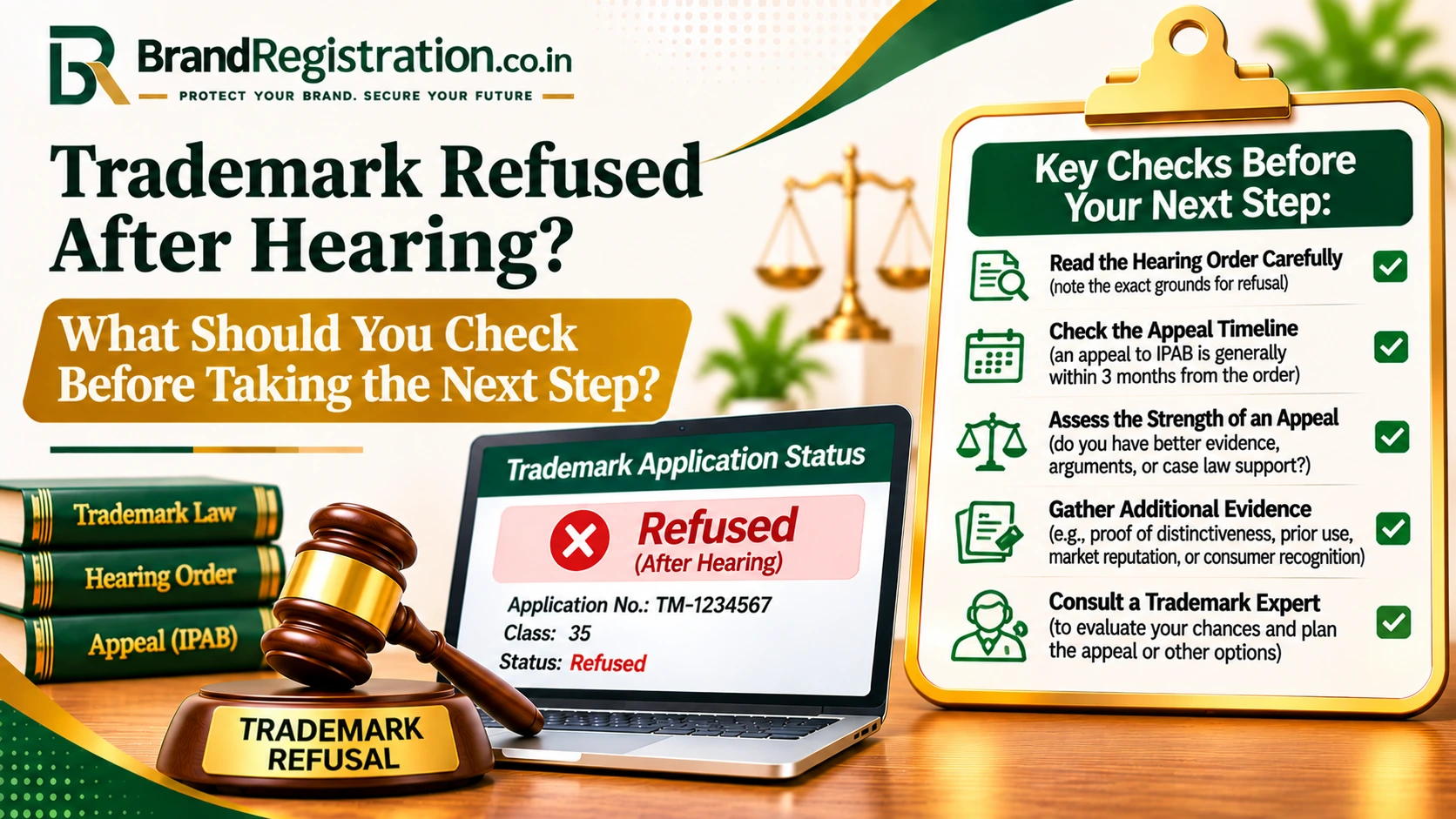
Table of Contents
If your trademark is refused after hearing, obtain the refusal decision and its reasons before choosing between a review, an appeal or a fresh application. Identify the date the decision was communicated and act promptly: the right route depends on what the Registrar decided, the evidence on record and the time available.
A status update alone rarely tells a brand owner whether to defend the original filing or change the brand. The comparison below helps you separate a flawed decision from a problem with the mark itself, then budget for the route that fits your business.
1. Trademark refused after hearing: 3 distinctions to make
A show-cause hearing gives an applicant an opportunity to address concerns raised during examination. If the Registrar subsequently refuses the application, the application has not secured registration through that decision. The written record tells you what was decided and which concerns remained.
First, an objection and a refusal are different stages. An examination objection identifies an issue to be answered; a refusal is a decision against registration of the application. An old examination reply may explain your position, but it is not a substitute for responding to the actual decision.
Second, “refused” is different from “abandoned”. Refusal concerns a decision on the application; an abandoned status indicates that the application has been treated as not pursued. The facts and available remedies differ, so do not assume instructions for an abandoned application apply to a refusal.
Third, a refused application is not the same thing as a finding that every use of the business name is unlawful. Registration and use are separate questions. Depending on the circumstances, use may still raise conflict or infringement concerns, especially where another business claims an earlier mark.
A company name and a brand name can be different. Company-name registration does not itself register the brand as a trademark, however, and a refusal of a trademark application should prompt a separate assessment of the name used on products, advertising and invoices.
2. What should you look for in the refusal order?
2.1 Find the decision and its reasons
Start with the application record through the trade mark services available from IP India. Search using the application number and inspect the available status, documents and correspondence. Save a copy of the decision or order if it is accessible, along with a record of when and how it was communicated to you or your representative.
If the record shows “refused” but you cannot find reasons, distinguish the status display from the underlying order. Gather the correspondence already received and pursue the reasons through the appropriate Registry process. A screenshot can establish what you saw on a date; it does not explain the Registrar’s reasoning or replace the decision.
A trademark speaking order gives reasons for the result rather than merely announcing it. Read the reasoning closely: does it identify the mark and application, the ground relied on, the cited material where relevant, and the basis for rejecting the applicant’s position? A short order is not automatically defective, but a missing explanation may materially affect how you frame a challenge.
2.2 Read the order against the application
Compare the decision with the exact mark and goods or services in the application. A business may use a word, logo and trading name together while its application protects only one particular representation. If the order appears to address a different feature or an incorrectly understood specification, record that discrepancy with the relevant page of the original filing.
Also compare the order with what was actually submitted before and at the hearing. Note whether the decision addresses the main points and supporting material, rather than assuming that every omission is decisive. Separate a disagreement with the outcome from a specific error you can demonstrate.
Create a short chronology with separate entries for the hearing, the date on the order, the date it reached you or your representative, and the date you first saw the online status. These dates can differ; preserving the supporting emails or records makes the chronology more useful than relying on memory.
3. Which refusal ground changes your evidence?
3.1 Section 9: the mark itself
Section 9 of the Trade Marks Act, 1999 concerns absolute grounds for refusal. For a typical brand application, the issue may be whether the mark distinguishes the applicant’s goods or services, or whether its wording describes them. Read the order for the particular objection; the section number alone does not identify the Registrar’s full reasoning.
Evidence should answer that issue. If the decision treats a term as descriptive, assess how the mark is used as a whole, what the term means in the relevant market, and whether the file contains evidence that customers associate it with your business. Invoices, advertising and customer-facing material are more useful when their dates, the mark displayed and the goods or services can be connected.
Changing a common descriptive phrase into a more distinctive brand may improve a future filing strategy, but it also changes the business asset being protected. If the name is central to existing packaging or customer recognition, the cost of that change belongs in the decision, not just the filing budget.
3.2 Section 11: an earlier mark
Section 11 concerns relative grounds, including conflict with earlier marks. Here the question is not simply whether your own mark looks attractive or has been used in advertising. The decision may turn on the earlier mark, the relevant goods or services and the likelihood of confusion in the circumstances.
Identify each cited application or registration and compare the marks as a whole. Look at the wording of the goods or services, not merely the class number. Two applications in one class do not necessarily cover identical offerings; conversely, a superficial class comparison does not settle whether businesses or customers could encounter related offerings.
Evidence of your sales can be commercially valuable without answering a similarity objection by itself. If the order relies on an earlier right, the next-step analysis should explain why the particular cited right does or does not support refusal. Where a commercial arrangement with the other party is being considered, its scope and legal effect require careful assessment rather than an assumed cure.
Some decisions rely on more than one ground. A successful argument against one objection does not necessarily remove another, so map each stated reason to a separate answer and the material supporting it.
4. Review vs appeal vs a fresh application
The three routes solve different problems. Compare them against the outcome you need: reconsideration of the existing decision, a court challenge to it, or an application for a different filing strategy.
Decision criterion | Review | Appeal | Fresh application |
|---|---|---|---|
Where it is pursued | Before the Registrar, where review is available. | Before the appropriate High Court, where an appeal lies. | Before the Trade Marks Registry as a new application. |
What you are trying to achieve | Reconsideration of the Registrar’s decision on an appropriate basis. | A court’s examination of the challenged decision and the relief sought. | Examination of a new filing, potentially for a changed mark or specification. |
When it may fit | You can identify a specific issue suitable for review of the existing decision. | The original application matters commercially and there is a substantive basis to challenge the decision. | The business is willing to change its filing strategy or brand rather than rely solely on the refused application. |
Main drawback | It is not a general promise of a second hearing on every argument. | Court procedure, representation and contested issues can add cost and complexity. | A new filing has its own application date and examination; the previous refusal is not erased. |
Switching cost | Time and preparation spent on a route that may not resolve every issue. | Commitment to litigation and its associated business and legal costs. | Possible redesign, packaging, customer communication and loss of reliance on the original filing for the new application. |
A fresh application can be attractive when the business has decided to adopt a genuinely different mark. Filing the same material again without addressing the stated reasons may reproduce the same problem. Equally, changing a logo may not solve an objection focused on the word element.
Hypothetical: A retail startup has invested heavily in a word mark for its services. If the order appears to misunderstand the evidence already on file, preserving a challenge to that decision may matter more than filing a redesigned logo. If the startup is already changing its trading name, a new application for the new name may serve a different commercial objective. Neither choice settles whether the other name or mark is available.
5. Who can act, and what documents should they assemble?
The applicant should first establish who owns the application and who is authorised to give instructions. A founder, company, partnership or other applicant should not be treated as interchangeable merely because the same person manages the brand. For an appeal, Section 91 addresses a person aggrieved by a Registrar’s order or decision; whether a particular person has standing depends on the circumstances.
5.1 Build the decision file
The following is a practical preparation list, not a universal statutory list for every route. The filing requirements depend on the proceeding and the applicable forum.
The application number, applicant details, representation of the mark, goods or services, and the original application.
The examination report, response, hearing notice, relevant submissions and evidence already filed.
The refusal decision and reasons, together with records showing when the decision was received or communicated.
Details of any earlier marks cited, including the relevant application or registration numbers and the goods or services identified.
Evidence supporting the proposed argument, organised by date and linked to the actual mark and offering.
Documents showing who can instruct a representative or sign for the applicant, where needed for the chosen filing.
5.2 Make the evidence useful
A large folder is not automatically a strong record. Label each item with the proposition it supports: for example, a dated invoice may show use of the mark on a particular product, while an advertisement may show how the public encountered it. Keep the original documents and a clear copy; avoid presenting later material as if it existed at an earlier date.
Check that the evidence relates to the applicant and the mark actually filed. Material bearing a parent company’s name, a different logo or an unrelated service can still need explanation before its relevance is clear. The distinction matters most when the proposed challenge depends on use or recognition of a particular mark.
For a court challenge, the existing Registry record may be central. Do not assume that every item gathered after the decision will automatically be treated as part of the original record; identify new material separately and assess how it can properly be presented.
6. How do you move from refusal to the chosen route?
Identify the decision, the person affected and the relevant communication records.
Place the time-sensitive dates in a shared calendar for the applicant and representative.
List each reason for refusal and the answer you believe the record supports.
Decide whether the objective is to challenge the existing decision, seek reconsideration where available, or pursue a new mark or specification.
Assess the available review route under Section 127 of the Trade Marks Act and the applicable rules if reconsideration by the Registrar is being considered.
A reference to Form TM-M should not be treated as proof that every post-refusal request uses the same filing category or fee.
For an appeal under Section 91, identify the appropriate High Court, the relief sought and the applicable court procedure.
Prepare the challenge against the decision and relevant record rather than treating it as another examination reply.
For a new application, prepare the exact mark, applicant and goods or services to be filed.
Form TM-A is the registration application form listed by IP India; a new filing should reflect the business’s actual brand and intended scope.
Keep proof of filing and payment, and record the next procedural event.
If a representative files, agree who will receive notices and who is responsible for responding.
The Trade Marks Act and Trade Marks Rules provide the statutory framework. High Court procedure is a separate consideration for an appeal. A review request and an appeal are not interchangeable, and pursuing one should not be assumed to suspend the time available for the other.
If an order or reasons are missing, preserve the evidence of your efforts to obtain them while assessing the applicable deadline. Do not wait for a complete commercial rebrand exercise before dealing with a potentially time-sensitive challenge to the existing decision.
7. What will each route cost, and how long can it take?
There is no single “refusal fee”. The budget depends on whether you request a Registry action, bring a court appeal or submit a new application. Official charges are only one component: obtaining and organising evidence, professional work and changes to a live brand can cost more than the filing itself.
Cost component | What to budget for |
|---|---|
New TM-A: individual, startup or small enterprise | IP India lists ₹4,500 for e-filing or ₹5,000 for physical filing, per mark per class, for the applicable category. |
New TM-A: other applicants | IP India lists ₹9,000 for e-filing or ₹10,000 for physical filing, per mark per class. |
Review or appeal | Allow for the applicable Registry or court charges, representation, document preparation and any other procedural expenses. The amount depends on the filing and forum. |
Brand change | Estimate design, packaging, website, advertising, customer communication and replacement of existing materials where relevant. |
The official amounts above come from IP India’s forms and fees schedule. For a new filing, multiply the applicable fee by the number of marks and classes being filed, then add the other costs separately. The reduced category depends on the applicant qualifying for it.
Decision date and communication date may not be the same.
Review and appeal have different procedures.
A fresh filing starts its own examination process.
Duration depends on the route, issues and forum.
The trademark refusal appeal time limit is a priority, but the supplied official material does not establish a precise period for the circumstances covered here. Obtain an assessment immediately using the actual order and communication record. There is likewise no reliable fixed duration for the Registry or court outcome in every case.
8. Which mistakes can weaken the next step?
Challenging the wrong document: An examination report explains earlier objections; the refusal decision is the decision you need to analyse for a post-hearing challenge.
Assuming a status screenshot is the whole record: A status label may omit the reasoning and the evidence considered. Keep it as a supporting record, not as your only account of the decision.
Arguing only the strongest point: If the decision gives independent reasons, leaving one unanswered can undermine a challenge even when another argument is persuasive.
Changing only the artwork: A new visual treatment may leave the same disputed word or market conflict intact. Assess what caused the refusal before paying for a redesign.
Mixing up the applicant and the trading brand: Evidence and instructions should be connected to the applicant’s identity and the rights asserted, especially when several related entities use the brand.
Backdating or overstating evidence: Claims about use should match the documents and their dates. An unsupported claim can weaken credibility rather than fill an evidential gap.
Treating a new filing as a cure for an existing dispute: A new application does not settle another party’s rights or guarantee registration.
For a trademark rejection after hearing, the most expensive error may be a business decision made without reference to the order: printing revised packaging, launching in a new market or abandoning a valuable name before identifying the actual obstacle.
9. What should you monitor after taking action?
Keep a central file for the chosen proceeding and monitor the contact details through which notices are expected. Record filing acknowledgements, payment receipts, orders and instructions to representatives. An application or challenge requires follow-through; submitting it does not itself produce a registration.
For a fresh application to trademark a business name, monitor the application as it moves through examination and any later stages. Respond to communications relevant to that filing. If the mark is eventually registered, maintain the registration and track the applicable renewal requirements; those obligations arise from the registration, not from a refusal order.
Keep the brand team informed about which mark was filed and for which goods or services. A marketing change can create a mismatch between the application and what customers see. Likewise, a new logo application should not be described internally as automatic protection for every version of the business name.
Where an appeal or review remains pending, maintain a separate record of the outcome and any further directions. If the matter is sent back for further consideration, the result is a further procedural step rather than an automatic registration.
10. Decision guide: choose the route for your business
Use the refusal record and your commercial plans to make the choice in this order:
Preserve the original application if it matters: If the existing mark is central to your business and the decision contains an identifiable error, assess the available challenge promptly.
Consider review for a suitable issue: If there is a specific basis for the Registrar to reconsider the decision, evaluate review against its applicable requirements and the available time.
Choose an appeal when a court challenge fits: If the relief sought requires challenging the Registrar’s decision before the appropriate High Court, weigh the legal basis and litigation budget.
File afresh for a genuine new strategy: If you are adopting a different mark or a properly considered specification, price the new filing and the brand-transition work together.
Keep the order, chronology and evidence map beside that decision. Compare options against your specific situation, then consult Brand Registration to confirm the best choice
Frequently Asked Questions
What does refused mean after a trademark hearing?
It means the application has been refused rather than accepted for registration through that decision. Read the refusal decision and its reasons to understand the grounds and assess the available next steps.
How do I find a trademark refusal order?
Use the application number to inspect the application record through IP India’s trade mark services and save the available decision and correspondence. If the status is visible but the reasons are not, pursue the reasons through the appropriate Registry process.
Can I challenge a refusal under Section 91?
Section 91 provides for an appeal by a person aggrieved by a Registrar’s order or decision. The appropriate High Court, filing requirements and applicable time limit must be assessed for the particular decision.
Is a trademark review the same as an appeal?
No. A review seeks reconsideration by the Registrar where the review route is available. An appeal challenges the decision before the appropriate High Court. Their procedures and requirements differ.
Can I file a fresh trademark application after refusal?
You can consider a new application for a new filing strategy, such as a changed mark or an appropriately chosen specification. It is examined as a new application and does not erase the earlier refusal or guarantee registration.
What is the official fee for a new trademark application?
IP India lists the TM-A fee per mark per class as ₹4,500 online or ₹5,000 physically for an eligible individual, startup or small enterprise. For other applicants, it lists ₹9,000 online or ₹10,000 physically.
Does a refused status mean I must stop using the name?
A refusal of an application does not by itself answer every question about use. Use may nevertheless involve risks if another party has relevant rights, so the refusal grounds and any existing dispute should be assessed.
Can a company name and a brand name be different?
Yes. A business can use a brand name that differs from its company name. Registering the company name does not itself register the brand as a trademark.