Trademark Status Shows “Formalities Chk Fail”: What Should You Check Next?
23 November 2026
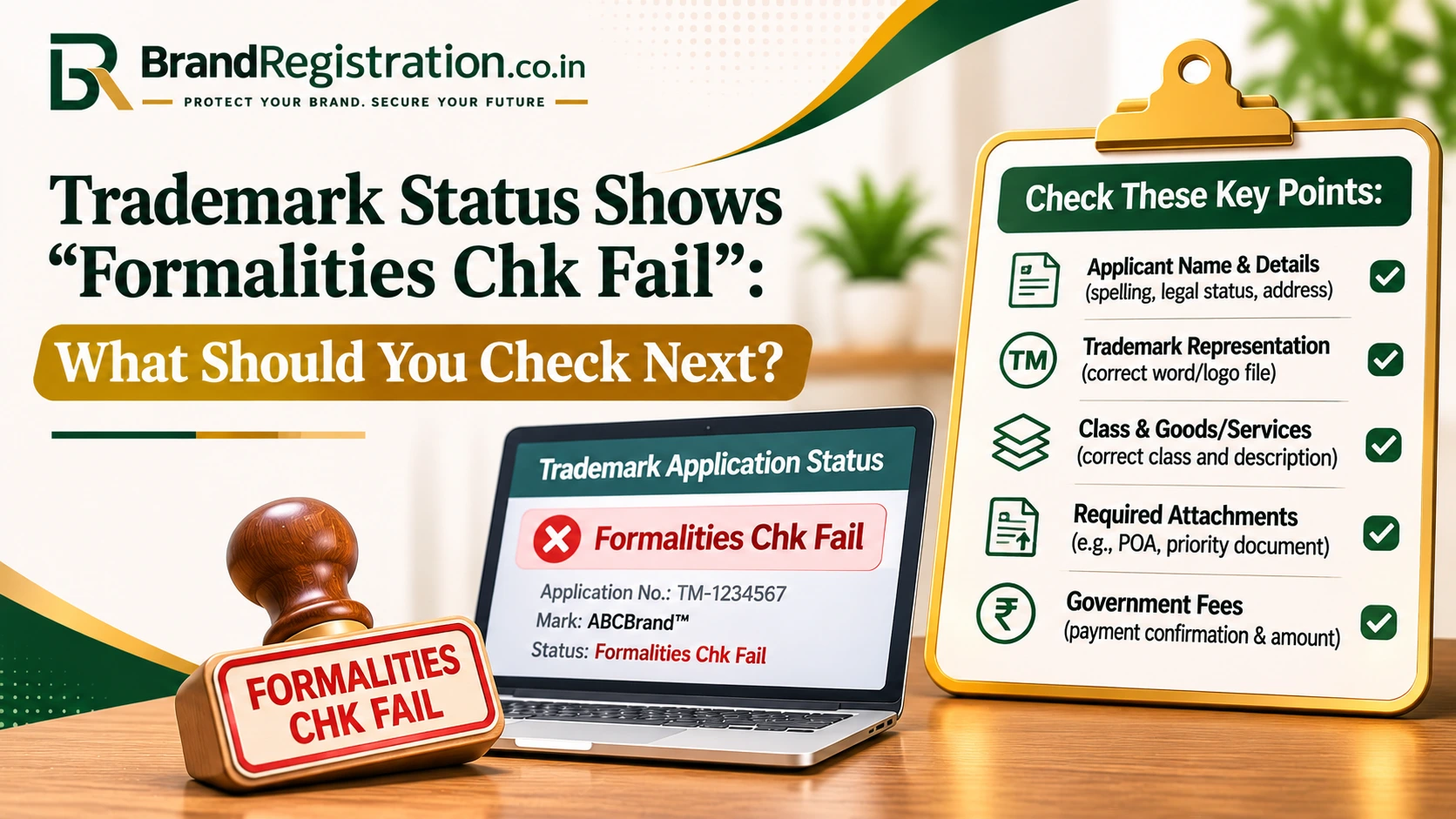
Table of Contents
If your trademark formalities chk fail status appears on IP India, first inspect the application record and any Registry communication to identify the specific deficiency. Prepare a response that addresses that issue, then use the submission route applicable to your case; the status alone does not tell you which document, form, fee or deadline applies.
The label can be unsettling when you have already paid for brand registration. It points to a problem at the preliminary paperwork stage, but it does not by itself establish that the Registry has finally refused your mark or that your response has been accepted.
1. What does trademark formalities chk fail mean?
1.1 A filing-stage issue, not a final decision
A trademark application begins with details about the applicant, the mark, the goods or services and other particulars relevant to the filing. Preliminary scrutiny concerns whether the application and associated material satisfy filing formalities. A failed check signals that something needs attention before you can confidently treat that stage as complete.
That is different from a substantive examination of whether the mark qualifies for protection. For example, questions about distinctiveness or a conflict with another mark concern registrability. A status label for a preliminary scrutiny failure should not be treated as a substitute for an examination report.
For a business owner, the immediate consequence is uncertainty about the application’s progress. You may have an application number, but that number is evidence of a filing, not proof of registration or exclusive rights in every use of the name.
1.2 What the status cannot tell you
The words on the status screen are a starting point, not a diagnosis. They do not identify whether the concern is an attachment, an entry in the form, a request for additional information or something else. Two applications with the same status may require different responses.
Do not assume that an online discussion about a missing authorisation describes your case. Read the actual record and any communication addressed to the applicant or representative. If the reason is not visible, establish what the Registry requires before choosing a correction route.
Passing the formalities stage also does not mean the mark is registered. Further scrutiny and other stages can follow. Keep those separate from the immediate question: what is preventing this application from clearing its preliminary check?
2. Who should act, and what should they establish first?
2.1 Identify the applicant and the person handling the file
The person who should arrange the response is the applicant or someone properly handling the matter for that applicant. That might be an individual brand owner, a business entity or its authorised representative. The person using the brand day to day is not necessarily the applicant named in the filing.
You do not need to have a company merely to apply for a trademark. An individual can apply for a business name as a trademark; the application must identify the actual applicant and the mark and describe the relevant goods or services. The same ownership question matters when an individual founder later forms a company.
A company name and a brand name can also be different. For example, a company might trade under a product brand that is unlike its registered corporate name. The question for the application is who owns or is applying for the mark, rather than whether the two names match word for word.
2.2 Decide whose application needs attention
Identify the application number and the mark associated with it, especially if the business has filed both a name and a logo.
Establish the applicant named in that particular filing and who is authorised to make decisions about it.
Find out whether an agent or employee controls the filing account and receives Registry correspondence.
Check whether the business has related applications that should be monitored separately rather than assumed to have the same status.
These are practical checks for organising a response, not a separate eligibility test for curing a deficiency. If a former service provider handled the application, agree who will communicate with the Registry and who will retain the file. A new adviser cannot safely infer the contents of the original filing from a brand name alone.
3. Documents to assemble before responding
There is no single response bundle established by the status label. The following is a working checklist for diagnosis and preparation, not an official checklist that applies to every application. The notice and the nature of the issue determine what is actually needed.
3.1 The original filing record
Application copy and filing acknowledgement: these identify the application and preserve what was submitted at the outset.
Status record and any Registry communication: these help establish the issue raised, the addressee and any response instructions.
Mark representation and particulars: the filed version shows the name, logo or other representation and the goods or services described in the application.
Applicant information: the original details and reliable records of the applicant’s identity help distinguish a data-entry error from a change of owner.
Earlier correspondence and submissions: these show whether an explanation or attachment has already been sent and what remains unresolved.
Keep copies in a readable format and retain the originals or signed versions where available. A complete application copy is more useful than a screenshot of the status alone: it lets the person preparing the response compare the Registry’s concern with the actual entries.
3.2 Supporting material relevant to the issue
If a representative filed the application, obtain the existing authorisation or power of attorney and its execution details. A “trademark power of attorney missing” search result is not evidence that this is the defect in your file. Its relevance and the form of any replacement depend on the communication and the filing arrangement.
If the application claims use of the mark, collect the use-related material already submitted, including any affidavit. A search for “trademark user affidavit missing” may help you understand a possible issue, but the status alone does not establish that an affidavit is missing or prescribe its wording.
For a mark containing words in another script or language, preserve the exact filed representation and any translation or transliteration already supplied. If further material is requested, it must correspond to the mark actually on the record. Where the Registry asks for a particular format or execution, follow that instruction rather than relying on a generic internet template.
Ask an earlier representative for both the documents and the submission acknowledgements. A document prepared for filing and a document demonstrably submitted are different parts of the record. Having both helps identify what information is available without assuming what the Registry has received.
4. How to investigate and respond on the IP India system
4.1 Prepare
Open the IP India website and locate the trademark application status service. The official application status page is an entry point for looking up the record.
Search using the application number and inspect the available details, documents and communications.
Record the date on which you reviewed the record and save the relevant material.
Identify the Registry’s stated concern and any instructions for responding.
If the status is visible but the reason is not, obtain the relevant communication or clarification before selecting a filing route.
Compare the requested correction with the original application.
Decide whether the task is to supply material, explain an existing entry or seek a change to the application; these are not necessarily interchangeable requests.
Prepare a focused response identifying the application, addressing the stated concern and referring to the relevant supporting material.
Follow any applicable instructions for the submission channel, format and payment.
Submit through the applicable official route and retain the acknowledgement, the final response and the attachments exactly as submitted.
A useful response connects each item requested by the Registry to the corresponding explanation or attachment. If there are several points, address them separately so that a reviewer can see what each part of the submission is intended to resolve. Avoid adding unrelated changes simply because the file is being opened for correction.
4.2 Submit
Do not assume that every formalities problem is resolved by a trademark MIS-F reply. A miscellaneous submission, an amendment request and a response to a particular communication may involve different routes or requirements. The correct choice depends on what the Registry has asked for and what you need to change.
If the filing was made through a representative, coordinate the submission rather than sending competing responses. Ask for a copy of what will be filed and an itemised explanation of any proposed charge. Where access or authority is in dispute, settle who is acting for the applicant before committing a response to the record.
If you cannot identify the applicable route from the communication and official filing information, obtain case-specific assistance. Making a guessed submission may produce a receipt without resolving the issue that stopped the application.
4.3 Preserve the outcome
Save the acknowledgement alongside the final response, not just in an email thread. Note the application number, submission date, reference number shown on the acknowledgement and the person who filed it. This creates a usable record if a later inquiry is needed.
If the portal reports a technical failure, keep the error details and distinguish an unsuccessful upload from a completed submission. Do not describe a response as filed merely because it was drafted or because payment was attempted. The record of a completed transaction is what you need for subsequent follow-up.
5. What can go wrong, and how should each issue be handled?
Common search terms point to several possible problems, but none proves the reason for a particular failed check. Use the Registry’s stated concern to select the relevant issue below. The correction should match the problem, not a standard response copied from another application.
5.1 Identity and representation
Applicant details mismatch: A spelling or data-entry discrepancy may look like an ownership change when the record does not clearly identify the applicant. Compare the filing with reliable identity records and explain the discrepancy precisely. If the intended correction would substitute a different person or entity, obtain advice on the permissible route rather than treating it as a typo.
Missing or defective authorisation: Where representation is the issue, distinguish a document that was never submitted from one submitted with a defect. An unexecuted copy or a document for a different applicant may not answer the concern. Use the requirement identified for the case and preserve the signed version and its filing record.
A founder’s personal application and a company’s application are not automatically the same file because they concern the same trading name. A request that affects who is shown as applicant can have consequences beyond clearing a preliminary check. That makes the original filing and the intended ownership decision especially important.
5.2 Class, mark and language
Wrong class or description: Compare the goods or services in the application with what the applicant intended to protect. A class problem can raise a substantive choice about the scope of the filing, not merely the upload of a missing page. Do not assume that changing the class is available or that a fresh application will retain the earlier filing date.
Unclear mark representation: A poor-quality image can make it difficult to tell what was filed. Preserve the original representation and assess whether a clearer copy would depict the same mark or whether the proposed image changes it. A revised logo is not automatically equivalent to a clearer copy of the original.
Translation or transliteration concern: Translation conveys meaning; transliteration represents how words in one script are written or sounded in another. If the Registry asks for either, answer the request for the words actually appearing in the mark. Do not add a translation for a different version of the logo.
A correction that changes the applicant, mark or scope can affect more than the immediate status. Do not promise yourself that the original filing date will cover a materially different application; assess the available route and its consequences before submitting.
5.3 Use claim and supporting material
Use-related deficiency: If the Registry identifies a problem with material supporting a use claim, address the specific request against the claim already made. Do not invent an earlier use date or change the claim simply to make a document fit.
Incomplete response: A response that addresses one point but overlooks another can leave the underlying issue unresolved. Match your explanation to each identified point and check that the intended attachments are actually included in the final submission.
For a complex identity, class or mark issue, specialist review can be more useful before filing than after an unsuitable amendment has been submitted. The question to put to an adviser is specific: what change is permitted, what will it affect, and what alternatives exist?
6. What will the response cost?
The cost depends on the action required. The supplied official material does not establish a universal government fee for this status, so a fixed amount would be misleading. A request to supply information should not automatically be priced as though it were an amendment, and a professional’s charge is separate from any Registry charge.
Government charge, if applicable: the amount depends on the applicable filing or request and its official fee schedule.
Professional fee: an adviser may charge for diagnosis, preparing a response, filing it and subsequent follow-up; ask which work is included.
Document preparation: obtaining, executing or preparing supporting material may involve separate expense depending on the case.
Alternative filing: if an adviser recommends another application, ask for that cost separately and why it is necessary.
Request a written breakdown before approving work. It should distinguish an official payment from the service fee and identify whether the quoted amount covers one submission or also covers further correspondence. A low initial quote may exclude the work needed if the Registry raises another point.
Keep the official payment receipt, where a payment is made, with the application record. If no charge is shown for a particular action, do not infer that every related request will also be free. The relevant fee is tied to the action taken, not to the wording of the status alone.
7. How long do you have, and when might the status change?
There are two different clocks: any response period applicable to a Registry communication, and the time the Registry takes to process what is filed. The status label alone does not establish a universal deadline or a predictable clearance date. Read the actual communication for its instructions and the date from which any stated period is calculated.
If a communication is sent to a representative, the applicant should obtain it promptly rather than wait for a status change. Keep a record of when it was received and who is responsible for acting. An unanswered request can put the application at risk, but the consequence depends on the applicable notice and circumstances.
Processing can vary with the nature of the issue, the completeness of the response and the Registry’s handling of the file. A submission may be visible before the status is updated; equally, a status that remains unchanged does not by itself prove that the response was accepted or rejected.
Set an internal review date after filing and compare the live record with the acknowledgement. If the application does not move or further communication appears, use the saved submission details for a targeted inquiry. Avoid promising a customer, investor or business partner a registration date based solely on the time taken for the formalities response.
8. What to monitor after submitting the response
First look for evidence that the response has entered the application record. Then monitor for a Registry communication or a change in the formalities position. These are separate events: an acknowledgement establishes a submission record, while the Registry’s subsequent treatment determines whether the concern has been addressed.
When the formalities issue is cleared, the application can move to later scrutiny. A subsequent objection concerns a different question and requires its own assessment. Do not reuse a document-deficiency response as an answer to an examination objection without addressing the grounds actually raised.
A show-cause hearing is an opportunity to address the Registry on an issue for which a hearing has been called. It is not another name for a formalities-failure status. If a hearing notice arrives, read its subject, instructions and date separately; the material needed will depend on the issue to be heard.
Continue watching the application and communications through the remaining stages. Publication can be checked in the official Trade Marks Journal when relevant. Publication, a filing receipt and a registration certificate are different milestones, so use the actual record when reporting progress internally.
Keep a single file containing the application, communications, submissions and acknowledgements. If responsibility moves from a founder to an employee or adviser, record the handover and the next review date. This reduces the chance that a later notice is missed because everyone assumes somebody else is watching it.
9. Your next three decisions
Retrieve the application record and the communication explaining the deficiency. If no reason is available, make obtaining it your first task rather than choosing a form by guesswork.
For a straightforward request you understand, prepare a point-by-point response and use the applicable official route. For a proposed change to ownership, the mark or its scope, get advice on the consequences before filing.
Keep the acknowledgement and assign someone to monitor the application. Budget separately for any official charge and for professional work, and ask the person handling the file what further work their quote covers.
Begin the process online via the official government portal, or engage Brand Registration for end-to-end assistance.
Frequently Asked Questions
Does a failed formalities check mean my trademark has been rejected?
No. The status points to an issue at the preliminary filing-formalities stage. It does not by itself establish a final refusal or identify the particular deficiency.
What if the status page does not explain the deficiency?
Review the available application record and Registry communications. If the reason is still unavailable, obtain the relevant communication or clarification before choosing a submission route.
Is an MIS-F reply appropriate for every formalities failure?
No universal route can be inferred from the status alone. The appropriate submission depends on the Registry's instructions and whether you are supplying information, responding to a communication or seeking an amendment.
Can an individual respond without having a company?
An individual can be a trademark applicant without forming a company. The applicant or someone properly acting for the applicant should handle the response for the particular application.
Can the company name and brand name be different?
Yes. A company can use a brand name that differs from its corporate name. The trademark application should identify the actual applicant and the mark for which protection is sought.
Does a wrong class always mean the application loses its filing date?
That conclusion cannot be drawn from the status alone. Whether a change is permitted, whether another application is needed and what happens to the filing date depend on the facts and the applicable procedure.
What is a show-cause hearing in a trademark matter?
It is an opportunity to address the Registry on an issue for which a hearing has been called. Read the hearing notice for the issue, date and instructions; a formalities-failure status alone is not a hearing notice.
Does a response receipt mean the trademark is registered?
No. A receipt records the submission; it does not establish that the Registry has cleared the deficiency or completed the later stages of the application.