Trademark Advertised in the Journal but Registration Certificate Not Received?
26 November 2026
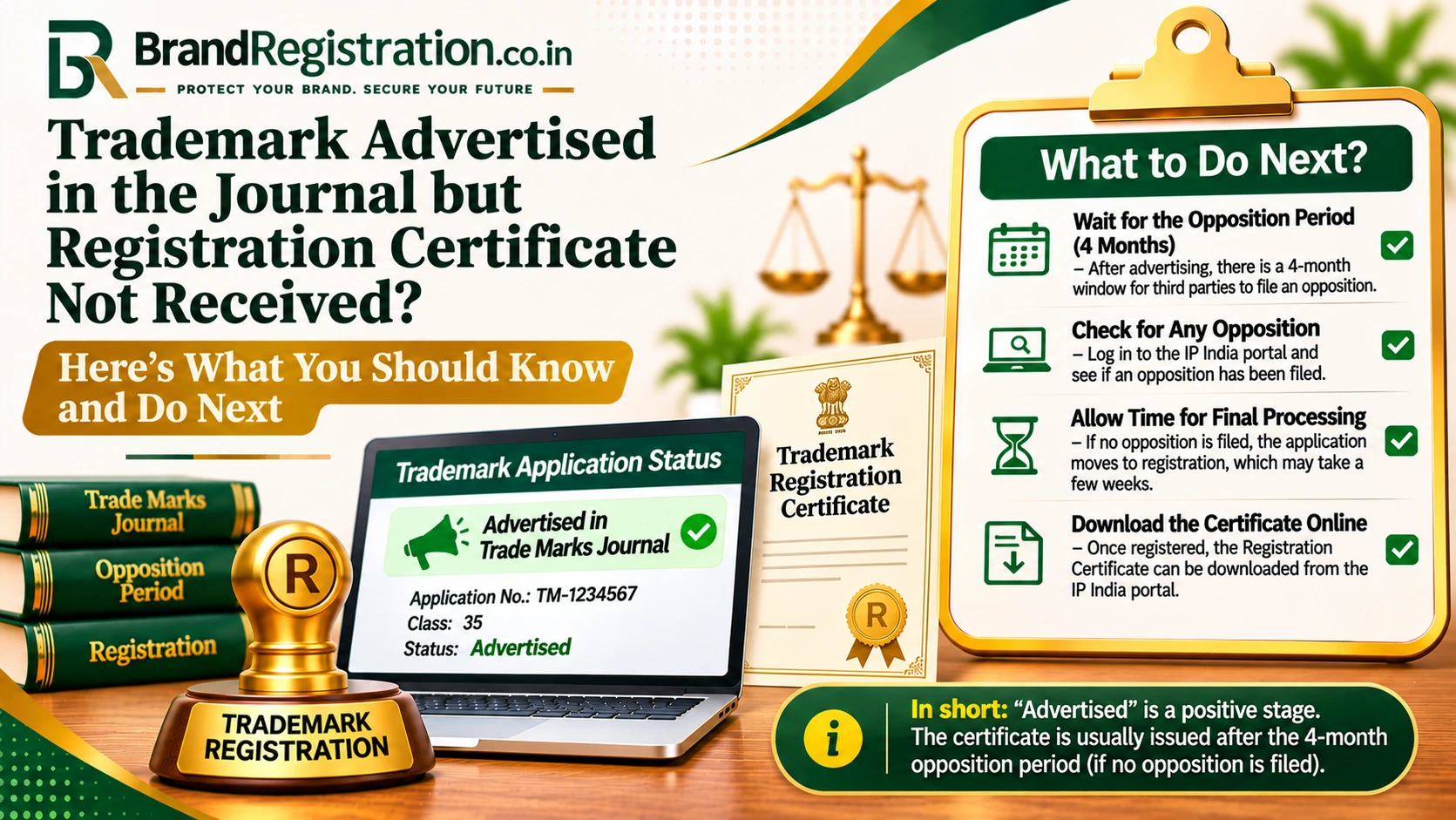
Table of Contents
If your trademark registration certificate has not been received after advertisement, first check the application’s current status on IP India. Publication opens an opposition period; it does not itself register the mark or guarantee that a certificate will appear as soon as that period ends.
A trademark that is still awaiting registration needs a different response from one marked “Registered” with no accessible certificate. Use your application record to identify which situation applies, then either address the outstanding proceeding or make a focused enquiry about the missing document.
1. Trademark registration certificate not received after advertisement: what the status means
1.1 Publication is a milestone, not registration
“Accepted & Advertised” generally indicates that the application has been accepted for publication in the Trade Marks Journal. The advertisement gives others an opportunity to oppose registration. It does not establish that the mark is already on the register.
Under Section 21 of the Trade Marks Act, 1999, notice of opposition may be given within four months from the date of advertisement or re-advertisement. Section 23 provides for registration where an accepted application is unopposed and the opposition period has expired, or where an opposition has been decided in the applicant’s favour, subject to the Act.
The distinction matters when explaining your position to a marketplace, investor or customer. A journal entry is evidence of publication; a registered entry and its certificate serve a different purpose. Describing an advertised application as “registered” can create a misleading impression about where it stands.
1.2 Which applications are ready for a certificate?
The application has been accepted and advertised or re-advertised, and the applicable opposition period has expired.
There is no opposition that prevents registration, or an opposition has been decided in the applicant’s favour.
The application remains eligible to proceed and has not been withdrawn, abandoned or otherwise disposed of.
The Registry has completed registration; a certificate can then be sought from the registered record.
These are conditions for moving toward registration, not a checklist of papers to upload for every status search. If a proceeding or order remains open, its effect on the application must be resolved before treating the issue as a missing download alone.
“Under Examination” is a different stage: the application is being examined and should not be assumed to have been accepted and advertised. If that is the status you see, read the examination-related record rather than looking for a registration certificate.
2. What to prepare before checking the record
For an ordinary status enquiry, assemble a small working file rather than creating a fresh registration package. These records help identify the application and explain the problem; they are not all statutory attachments for an online search.
Application number: keep the number from the filing acknowledgement in text form so you can enter it accurately and quote it in correspondence.
Applicant and mark details: note the proprietor’s name as filed, the mark and the relevant class. These are cross-checks that help distinguish your entry from a similar one.
Publication details: retain the journal number, publication date and relevant page or extract if available. These help identify the advertisement you are relying on.
Current status record: save a PDF, printout or screenshot showing the status and the date on which you viewed it. If a certificate link produces an error, preserve the error message too.
Relevant correspondence: keep any Registry notices, orders and your responses in date order. They can show whether the issue concerns a proceeding rather than the certificate file.
Representative details: if an agent filed the application, have their contact details and a copy of the authorisation on hand where available. A new representative can explain any authority needed for the particular work they undertake.
Digital copies are useful for a remote enquiry. For a formal request, use the format and supporting material specified for that request; an enquiry about a missing file should not be confused with an application for a certified document or a contested proceeding.
A company name and brand name can differ. The record should still identify the actual applicant or proprietor and the mark applied for, rather than assuming that the company’s legal name must also be the brand.
3. How to check, download or escalate the missing certificate
3.1 Use the application record
Open IP India, the official portal of the Trade Marks Registry, and navigate to its trade mark application status or e-register service.
Use the application number to locate the record; follow the access instructions displayed by the service.
Open the matching entry and read the current status, not only the journal details.
Review the available history and documents for any notice, order or proceeding relevant to the application.
If the entry is marked “Registered”, look within the available record for the registration certificate or associated document and open or save it if offered.
Keep the downloaded file with your application records.
If the application is still pending, identify the outstanding stage shown in the record.
An opposition, for example, requires attention to the proceeding rather than a certificate-download request.
If the entry is registered but the certificate is absent or inaccessible, record the status, the access problem and the date.
Contact the relevant Trade Marks Registry through the contact information published on IP India, or ask the filing representative to raise the issue.
Keep a copy of the enquiry and any response or reference number.
Follow up on that same issue if necessary, adding new information rather than sending a series of unrelated requests.
The public search used to look for potentially similar marks serves a different purpose from inspecting the history of your own application. When a search result resembles your mark, use the application number and proprietor details to ensure you are reading the right record.
Portal screens and access requirements can change. The important sequence is to find the official application entry, determine its present status and use the document or contact option shown for that service. Do not pay a third party merely because a search result resembles an official page.
3.2 Send a focused enquiry when needed
A useful enquiry states the application number, proprietor, current status and the exact problem: for example, that the entry is registered but no certificate is visible, or that a visible document will not open. Include the date of your attempt and any error message. If the application is still pending, ask about the identified pending stage instead.
Request a response or reference that you can retain with the application history. A complaint about access is not a substitute for a response to a legal notice, and an enquiry does not itself change the status of the application. Where a notice calls for action, read that notice and its deadline separately.
If you did not file the application yourself, your original representative may have correspondence that is not apparent from your own records. Ask for the application history and any current instructions. You can also seek assistance through Trademark Registration at Brand Registration, with the scope of the work agreed in advance.
4. Which document do you actually need?
Before requesting another document, identify what the recipient has asked you to provide. A missing first certificate, a replacement for a document already issued, and a certified record are different requests.
Your need | Relevant document | Decision point |
|---|---|---|
Keep evidence of an existing registration in your business records | The registration certificate available for the registered application | Look for the certificate on the official record before requesting another document. |
Provide formally certified evidence of a register entry | A certified copy or extract appropriate to the recipient’s requirement | Ask the recipient what record and certification it requires; a certificate and a certified extract are not interchangeable in every context. |
Replace a certificate already issued but no longer available to you | A replacement or duplicate, if the applicable Registry procedure provides for it | Explain that the original was issued and what happened to it, rather than describing the application as awaiting first registration. |
Show that an application has been published but is still pending | The application status and journal publication record | These show progress; they do not establish that registration has been completed. |
A recipient’s request for “proof of trademark” can be ambiguous. Ask whether it needs the certificate itself, the current register particulars, or a formally certified copy. This question can prevent paying for a document that does not satisfy the recipient’s requirement.
Search results may refer to a trademark registration certificate Form RG-2 or other form names. Do not select a request merely from a search snippet: identify the document and purpose first, then use the current instructions for the applicable Registry request.
5. Government charges and professional fees
There is no basis to assume that every delayed certificate requires a new trademark application or a new application fee. The cost depends on the action needed: viewing a record, making an enquiry, requesting a formal document, correcting a record or dealing with a contested proceeding are different activities.
Activity | Government charge | Possible professional charge |
|---|---|---|
Reviewing the application record | No separate filing is inherent in simply reviewing the record. | An adviser may charge for reviewing the history and reporting on it. |
Enquiring about a missing certificate | The cost depends on whether a formal chargeable request is required for the action taken. | A representative may quote for preparing and following up the enquiry. |
Requesting a certified or replacement document | Applicable charges depend on the document and request under the current official fee schedule. | Preparation, submission and follow-up may be billed separately. |
Responding to opposition or correcting an entry | Charges, if applicable, depend on the specific proceeding or request. | Fees can vary with the work, hearings and correspondence involved. |
Ask for a written estimate that separates government payments, professional fees and any taxes or other disbursements. For a status review, also ask whether the quote includes a written assessment and follow-up or only an initial search. An opposition response is materially different work from retrieving an accessible certificate.
There is no verified fixed price for Brand Registration’s work in the information available here. Agree the scope and price before engaging any representative, especially if the initial enquiry may reveal a contested matter requiring a separate quote.
6. How long can registration take after journal publication?
6.1 The statutory milestone
The four-month opposition period is measured from the date of advertisement or re-advertisement under Section 21. Use the actual publication date, not the date you received an acceptance message or the date you first noticed the entry. A re-advertisement may also matter to the calculation.
Four months is an opportunity for opposition, not a statutory promise that the certificate will be delivered on the next day. If your trademark certificate has not been received after four months, the useful question is what the application record now shows and whether any proceeding affects registration.
For example, a business may see that the four-month period following publication has passed but still see an advertised status. That observation alone does not establish whether a notice has been filed, whether an administrative step remains, or whether the displayed record is complete. The record and relevant correspondence provide the next evidence to assess.
6.2 What can extend the wait
An opposition changes the path because the contested application must be dealt with before it can proceed on that basis. Other application-specific matters or administrative processing may also affect timing. Their effect depends on what is recorded and communicated in the individual case.
If an opposition notice is served, Section 21 provides for a counter-statement within the prescribed two-month period after receipt; failure to send it results in the application being deemed abandoned. The notice and service date therefore require prompt attention. A certificate enquiry should not displace that response.
No reliable official post-publication benchmark for certificate generation is established by the supplied material. Treat online claims of a fixed number of days or weeks as estimates rather than a deadline you can enforce. Keep the publication and enquiry dates so that any follow-up has a clear history.
7. Mistakes that send a certificate enquiry down the wrong path
Using the acceptance date as the journal date. This can produce an inaccurate opposition-period calculation. Locate the actual advertisement, including any re-advertisement, before drawing a timing conclusion.
Assuming no opposition exists because no email arrived. A missing message does not establish the legal position. Review the application history and correspondence, and investigate any proceeding shown there.
Searching with the wrong application number or relying on a similar brand entry. The result may belong to another proprietor or application. Match the number and proprietor before using the record or contacting the Registry.
Filing a fresh trademark application solely to obtain a missing certificate. A new application is a separate matter and does not retrieve the certificate for an existing registration. Diagnose the original record first.
Treating a certificate problem as the cause of every pending status. If a notice, order or opposition is outstanding, the application may need substantive action. Address that matter through the appropriate proceeding.
Ignoring a discrepancy after the certificate becomes available. A name, mark or goods description that differs from the register or filing record may create difficulty when the document is used. Identify where the discrepancy appears before selecting a correction request.
Do not represent a mark as registered merely because it appeared in the Journal. Section 107 of the Trade Marks Act addresses false representation of a trademark as registered; use the registered symbol only when the legal position supports it.
Some discrepancies are only differences between a trading name and a proprietor’s legal name; others may concern the registered particulars themselves. Preserve the relevant records and describe the discrepancy precisely rather than assuming that every difference calls for the same correction.
8. What to do after registration
Read the certificate alongside the registered entry. Record the proprietor, the mark and the goods or services covered, including any conditions or limitations shown. Use that scope when explaining what your registered brand protects; a certificate should not be treated as proof of registration for every business activity.
Keep a secure copy of the certificate and the underlying application history, with access for the person responsible for IP. If a bank, platform or commercial partner needs proof, provide the document it actually requests and retain a record of what was shared.
Under Section 25 of the Trade Marks Act, registration is for ten years and may be renewed for further ten-year periods. Section 23 provides that, when registered, the trademark is registered as of the application date, subject to the Act. Record the renewal date shown in the official entry and plan the renewal in advance; do not assume it runs from the day you downloaded the certificate.
Monitor the mark and keep ownership information in your business records current. If ownership or other registered particulars change, assess the appropriate Registry action for that change. Monitoring and internal reminders are practical safeguards; they are distinct from the statutory renewal requirement.
Using a brand while an application is pending and claiming it is registered are different things. Once registration is established, use any registered symbol consistently with the registered mark and its scope. Marketing teams should have the same particulars as the person managing the legal record.
9. Choose your next three actions
Open the official IP India application record. If it remains advertised or shows a proceeding, identify that stage and the next action it calls for; if it is registered, look for the certificate in the record.
For a registered entry with an inaccessible or absent certificate, prepare one concise enquiry with the application number, status and access problem. If a third party needs proof, establish whether it wants the certificate or a certified record.
Choose the level of help that fits the issue. A straightforward status check may be manageable yourself; an opposition, disputed record or formal document request may justify a defined professional engagement.
Begin the process online via the official government portal, or engage Brand Registration for end-to-end assistance
Frequently Asked Questions
Does publication in the Trade Marks Journal mean my trademark is registered?
No. Publication gives others an opportunity to oppose the application. Registration is a later stage, subject to the Trade Marks Act and the outcome of any opposition.
Why has my trademark certificate not arrived after four months?
Four months is the statutory period for giving notice of opposition from advertisement or re-advertisement; it is not a guaranteed certificate-delivery deadline. Check the IP India application record for its current status and any proceedings.
What should I do if my trademark status is Registered but the certificate is missing?
Look for the certificate in the official application record. If it is absent or cannot be opened, record the application number, status, date and error, then contact the relevant Trade Marks Registry using the contact information on IP India.
What happens if someone opposes my trademark application?
The opposition must be addressed before the application can proceed on that basis. Section 21 provides for a counter-statement within two months after receipt of the opposition notice; failure to send it results in the application being deemed abandoned.
Do I need a company to apply for a trademark?
No. An individual can apply for a trademark; a company is not the only possible applicant. The application should identify the appropriate proprietor.
Can my company name and brand name be different?
Yes. A company may use a brand name different from its legal name. The trademark application should correctly identify both the proprietor and the mark for which protection is sought.
How can I trademark my business name?
Identify the name and the goods or services for which you seek protection, assess existing marks and file the appropriate application with the Trade Marks Registry through IP India. Company-name registration alone does not complete the trademark application process.
What does Under Examination mean in a trademark status?
It indicates that the application is at the examination stage. It should not be treated as proof that the application has been accepted, advertised or registered.