Trademark Application Shows “Abandoned”: What Are Your Options?
24 November 2026
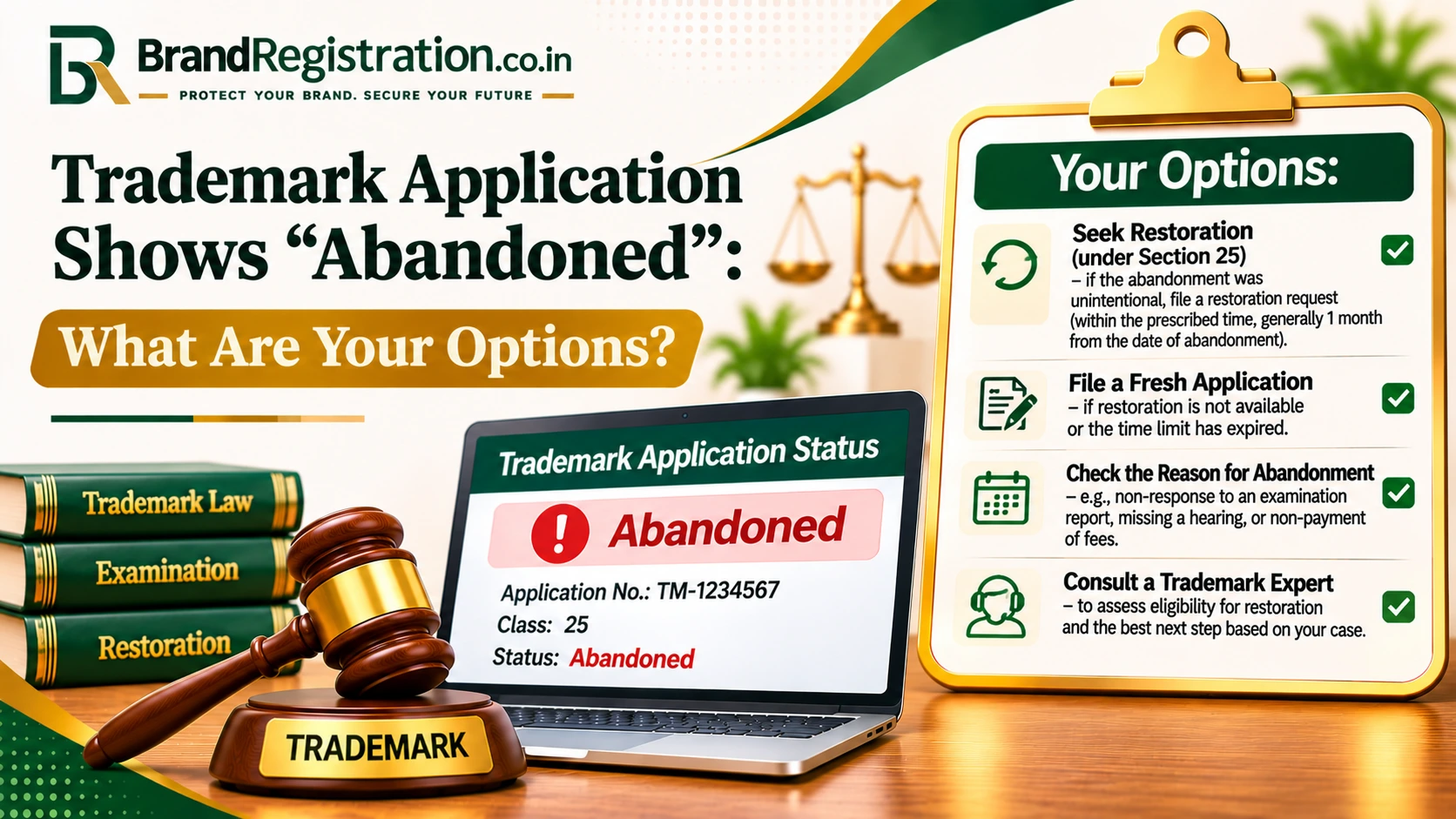
Table of Contents
If your trademark application shows “Abandoned”, first find out what happened on the application record. Depending on the facts, you may be able to challenge the abandonment, file a fresh application, or choose a different mark; revival is not automatic.
The right choice depends on more than the status displayed on IP India. You need to know which step was missed, what the Registry communicated, whether the record is accurate, and how much the earlier application matters to your business.
This guide helps you make that decision, assemble the useful records and budget for a new filing. It also explains what to keep monitoring after you act, so a second application does not encounter the same avoidable problem.
1. Trademark application abandoned: what the status means
1.1 A procedural status, not a complete explanation
An abandoned status generally indicates that the application is no longer moving through the registration process. It is different from a registration certificate and should not be treated as evidence that the mark has been registered.
Abandonment and refusal are also different labels. A refusal concerns a decision not to register the application; an abandoned status commonly points to a procedural default. The status alone, however, does not tell you which communication or event led to it. The underlying documents matter.
Nor does abandonment by itself establish that someone else owns your brand. Your position may depend on other applications, registrations, actual use and the facts of a dispute. Equally, continued use of a name does not automatically make a later registration application successful.
The IP India trademark application workflow provides a general picture of how applications move through examination, publication and possible opposition. Your individual application record is the starting point for understanding where yours stopped.
1.2 Where the application may have stalled
A file can run into difficulty at several stages. An examination report may require a response, a procedural communication may request action, or an opposition proceeding may require the applicant to take a further step. A status appearing after one of these events calls for the corresponding communication and filing history, rather than an assumption about the cause.
A show-cause hearing in trademark proceedings is an opportunity for the applicant to address issues raised in the application process. A missed hearing deserves careful investigation, but the effect depends on the notice, the stage of the case, prior filings and the applicable rules. Do not assume that every missed hearing automatically produces the same outcome.
Similarly, “abandoned after opposition” should prompt a review of the opposition record, not a conclusion that the opponent has won a separate ownership dispute. The immediate question is what happened to this application and what decision or entry explains its present status.
2. Who can act, and which route fits the facts?
2.1 Who should make the decision
The applicant named on the record has the direct interest in the application. That might be an individual, a company or another business entity. A founder or employee investigating the matter should identify the recorded applicant before instructing a representative or committing the business to a new filing.
If an agent handled the original work, ask for the complete case file and correspondence history. A replacement adviser needs authority from the appropriate applicant; an internal marketing contact should not assume that control of the brand account is the same thing as authority to act on the trademark file.
There is no single set of facts that makes every abandoned application eligible for revival. The available route depends on the nature of the Registry action, applicable law, the evidence and any relevant time limits. A request for review, an appeal and a fresh application are different steps, not interchangeable names for a universal restoration procedure.
2.2 Compare the available paths
Option | What it seeks to do | What to weigh |
|---|---|---|
Challenge or seek an available remedy concerning the existing application | Address the action affecting the earlier file | The legal basis, supporting evidence, timing and value of the earlier application |
File a fresh application for the same mark | Start a new registration application | A new application date, official fees and the current landscape of similar marks |
Apply for a changed mark | Seek protection for a revised name or logo | Search results, the scope of the new mark and the commercial cost of a brand change |
Pause and investigate | Preserve decision-making time while facts are assembled | Potential deadlines and the risk of leaving the issue unattended |
A business may consider more than one path, but a new filing does not itself undo an abandonment entry on the old file. Likewise, pursuing an available remedy does not guarantee that the original application will resume or that the mark will be accepted.
The earlier application may matter particularly where the brand has been in use for some time or where other similar applications have appeared. Its value depends on the full record, not merely on the age of the receipt.
3. What documents should you collect?
There is no universal document bundle for every possible remedy. Assemble the records below as an investigation file first; the papers needed for a particular application or challenge depend on the procedure eventually chosen.
Application details: application number, filing receipt, applicant name, representation of the mark, goods or services, and classes covered.
Registry communications: examination report, procedural notices, hearing communications, opposition papers and any order or document explaining the abandoned status, where available.
Proof of action: copies of replies, filing acknowledgements, payment receipts, delivery records and correspondence with the original representative.
Service and timing records: emails and envelopes or other records showing when communications were sent or received, together with any change in contact details.
Authority and ownership records: relevant authorisation, representative details and documents explaining changes in the applicant or business, if applicable.
Brand-use material: dated invoices, packaging, advertisements and other business records that may support an accurately stated use history.
Keep originals or reliable copies alongside a chronological index. A screenshot of the current status is useful for recording what appeared on a particular day, but it is not a substitute for the report, notice or order behind that status.
Separate what you can prove from what someone recalls. For example, “our agent says a reply was sent” is a lead; a copy of the reply and its filing acknowledgement provide a more useful basis for assessing the record. If a document is missing, note who may hold it and when you requested it.
4. Step-by-step: investigate and choose your next filing
4.1 Read the record before selecting a procedure
Locate the application on IP India. Use the trademark application number to find the status and available case details. Record the applicant, mark and class information so you are looking at the correct file.
Collect the case history. Obtain available communications and documents from the portal and the person who previously handled the matter. Identify any missing records instead of filling the gaps from memory.
Build a dated timeline. Place the filing, Registry communications, responses, hearing events and status change in order. Record both the date on a communication and any evidence of when it was received.
Identify the immediate issue. Decide whether the evidence points to an apparent record error, a disputed communication, an acknowledged missed step or an unresolved question. Note any deadline that may affect an available remedy.
Select the appropriate route. Assess the legal basis for a challenge to the existing action against the commercial case for a fresh application or revised mark. Review and appeal routes require separate assessment; do not select a form solely because it contains the word “restoration”.
File the chosen submission and retain proof. Use the procedure applicable to that submission, keep a copy of everything filed and record the acknowledgement and any fee receipt. For a fresh registration application, the official forms schedule identifies Form TM-A.
Monitor the resulting record. Assign a person to watch the old and any new application, read subsequent communications and update the internal case timeline.
The Trade Marks Act, 1999, the Trade Marks Rules, 2017 and the relevant case record are the legal and procedural starting points. The IP India workflow is useful for orientation, but it is not a substitute for identifying the provision that applies to your facts.
If you use a representative, agree in writing who will receive communications, who will decide on a response and who will file it. A handover is complete only when the new handler has the records and the business knows how notices will be monitored.
5. When is a challenge to abandonment worth considering?
5.1 A disputed record
Start with the strongest document that appears inconsistent with the Registry record. An acknowledgement for a reply, for instance, may call for examination if the file appears to show that no reply was received. Match its application number and contents to the relevant communication; proof that a different document was filed does not resolve the issue.
A claim that an application was abandoned without notice also requires careful reconstruction. “We did not see a notice” and “no notice was issued or served as required” are different propositions. Review the recorded contact details, the communications available on the file and the evidence held by the applicant and representative.
Section 132 of the Trade Marks Act addresses default in prosecution. Its application, and the relevance of any other provision, must be assessed against the actual action taken and the records in the case. Avoid assuming that a single notice argument decides every abandonment, particularly when the file arose at a different procedural stage.
5.2 A missed step acknowledged by the applicant
Where the evidence shows that a required action was missed, prepare an accurate explanation of what happened and when it came to light. Supporting records may help an adviser assess whether any remedy is available, but an explanation alone does not create a right to reopen the application.
An abandoned trademark application review petition and a trademark abandonment appeal are often mentioned together in searches. They are not automatically available in the same circumstances. The relevant decision, legal basis, forum and time limit must be identified before choosing either description or submitting papers.
Keep the commercial decision separate from the legal argument. A challenge may be worth assessing because the earlier application is valuable, while a fresh filing may also be attractive for a current product launch. Whether the routes can sensibly be pursued together depends on the facts and the applicable procedure.
6. Fresh filing: what changes for your brand?
6.1 Choose the applicant, mark and coverage
To trademark a business name through a fresh application, identify the person or entity that should own it, the exact name to be protected, and the goods or services for which protection is sought. Search for similar marks before deciding the scope, then prepare the registration application on Form TM-A.
The company name and the brand name can be different. A company may sell a product under a separate brand, but registering the company name is not the same process as obtaining trademark registration for that brand. Make sure the applicant and the mark in the new filing reflect the intended ownership and commercial use.
A word mark and a logo also answer different business needs. The word may be valuable across changing designs, while a logo filing describes the visual mark submitted. Where both matter, consider their separate scope and cost rather than assuming that one application necessarily covers every future version of the branding.
Individuals can be applicants; incorporation is not a prerequisite merely to seek trademark registration. If a business has changed from an individual operation to a company, decide who should own the new application and document the basis for that decision rather than copying the old applicant field without thought.
6.2 Account for the new application date
A fresh filing is a new application, not a continuation of the abandoned one. Its own filing date and details must be considered when assessing the position on the register. Do not assume that the new application automatically carries forward the earlier application's date or any priority claim.
Search for identical and similar marks, including marks relevant to the goods and services you plan to cover. Pay attention to filings that appeared after your original application as well as earlier records. The implications of another mark depend on its particulars and the law; a date alone does not settle every dispute.
Illustrative example: A studio filed for a brand used on design services, then discovered the application was abandoned. Before applying again, it also began selling printed products. The new filing decision should address whether the old service description still matches the business and whether the product activity calls for different coverage.
If the original mark has a serious conflict or no longer fits the business, a revised name or logo may be more useful than repeating the filing unchanged. Include the cost of changing packaging, domains, customer communications and marketplace listings in that decision. Brand Registration's Trademark Registration service is relevant if you decide to pursue a new application.
7. Government fees and timing
The following fresh-filing figures come from IP India's Forms & Official Fees page and relate to Form TM-A. They are government charges, not a quote for professional work or a challenge to an abandoned application.
Applicant category | Filing method | Official fee |
|---|---|---|
Individual, startup or small enterprise | E-filing | ₹4,500 |
Individual, startup or small enterprise | Physical filing | ₹5,000 |
Other applicants | E-filing | ₹9,000 |
Other applicants | Physical filing | ₹10,000 |
The official schedule states that the application fee is for each class and each mark. For budgeting, count the marks and classes you intend to file, then apply the relevant category and filing method. Eligibility for a reduced category depends on the applicant's circumstances; do not assume that every business qualifies.
7.1 Budget beyond the official filing fee
Ask for a written breakdown of any search, drafting, representation, response or hearing charges before engaging a service provider. These are separate from the government application fee and may depend on the work needed. A fresh filing can also lead to later professional costs if the Registry raises issues or another party opposes it.
For a proposed review, appeal or other challenge, the applicable fee and procedure depend on the remedy selected. Do not budget for one standard “revival fee” without first identifying that remedy. Rule 10 of the Trade Marks Rules links prescribed fees to the First Schedule and provides that a document filed without a required fee, or with an insufficient fee, is deemed not filed for the purposes of proceedings under the rules.
7.2 Plan for uncertainty
Investigation time depends on how quickly the complete file can be obtained and whether evidence of service or filing is missing. The time needed for a challenge or a new registration process also depends on the procedure, Registry action and any objections or opposition. There is no reliable single completion period for every abandoned application.
For business planning, distinguish the date you submit a new application from the later outcome of examination and any further proceedings. If a launch or packaging order is imminent, make the commercial decision with that uncertainty visible rather than treating filing as a registration approval.
8. What should you do after taking the next step?
8.1 Set up ownership and correspondence controls
Assign one accountable person to each application and a backup who can access the case file. Keep the applicant's details, representative's contact information, application number and a log of communications together. Record who is authorised to approve a response and who is responsible for filing it.
Where an adviser handles the matter, agree on how portal updates and correspondence will be reported. A notice passed to a former employee or an unattended shared inbox can create the same operational problem as a missed internal deadline. When people or advisers change, transfer the file and monitoring responsibility explicitly.
Track each mark and class covered by the business's applications. A business with a name, several logos and multiple product lines may have different application records at different stages. A single calendar entry labelled “trademark” is rarely enough to show which file needs attention.
8.2 Keep external claims accurate
Review packaging, websites and marketplace listings for statements that imply a registration has been granted when the relevant application is still pending or abandoned. An application receipt, a brand launch and a registration certificate are different things; your internal team should know which document supports each claim.
Continue keeping dated business records that show how the mark is actually used. Store versions of the name and logo as well as records connecting them to the relevant products or services. These records can make future ownership and use questions easier to assess, even though they do not guarantee registration.
If registration is eventually granted, record the registration details and establish a separate maintenance calendar. Renewal concerns a registered mark; it should not be confused with a request concerning an abandoned application.
9. Mistakes that make recovery harder
Treating a status screenshot as the full decision. It identifies a problem but may not explain the provision, communication or action behind it.
Filing a generic request without identifying the remedy. A document labelled “restoration” does not establish that the chosen procedure applies to the case.
Assuming no reply was filed because the current handler cannot find one. Search the original representative's records and payment history before describing the facts in a submission.
Ignoring the stage of the proceeding. A trademark abandoned after examination, an opposition-stage problem and a missed hearing may involve different records and legal questions.
Copying an obsolete specification. A business may have expanded or changed its products since the original filing; the new application should reflect the intended coverage accurately.
Using a new filing to conceal an ownership question. Resolve who should be named as applicant rather than making inconsistent filings in the names of a founder and a company without considering the consequences.
Overlooking the cost of a changed brand. A replacement mark can affect stock, contracts and customer recognition as well as the application budget.
10. Your decision checklist
If you have proof that the required action was taken, organise that proof against the Registry record and assess the appropriate remedy for the apparent discrepancy. If the issue is trademark abandonment due to non-filing of a reply, document the lapse honestly and assess whether a remedy is available before relying on a promise of revival.
If the earlier application is commercially important, weigh the value of addressing its status against the time and cost involved. If you need a new application, decide the owner, mark and coverage using the current business plan and search results. If the mark itself presents a serious commercial or conflict concern, price a revised brand before committing to new stock.
Start with the application number and complete case file; choose the legal or fresh-filing route only after the facts are clear. Take the next step with Brand Registration or the relevant government portal
Frequently Asked Questions
Does an abandoned status mean someone else owns my trademark?
No. The status concerns the application and does not by itself establish another person's ownership. Other applications, registrations and actual use may still affect your position.
Can an abandoned trademark application be revived automatically?
No. An available remedy depends on the action taken on the file, the applicable law, evidence and timing. A fresh application is a separate option, not automatic revival.
What if the Registry record appears to say that no reply was filed?
Collect the reply, filing acknowledgement and payment records, and match them to the application number and relevant communication. Those records can help assess whether the file contains an error and what remedy may be available.
Does a fresh application retain the abandoned application's filing date?
A fresh filing is a new application with its own filing date. Do not assume that the previous filing date or a previous priority claim carries over automatically.
Can I continue using my brand after its application is abandoned?
Abandonment of an application does not by itself decide every question about use of the brand. Other parties' rights and the facts of the business may affect whether continued use creates a dispute.
What is the official fee for a fresh trademark application?
The published TM-A e-filing fee is ₹4,500 for an individual, startup or small enterprise and ₹9,000 for other applicants. Physical filing is ₹5,000 and ₹10,000 respectively. The schedule states that the application fee is for each class and each mark.
Can a company name be different from its brand name?
Yes. A company can trade under a brand name different from its company name. Company-name registration and trademark registration are separate matters, so the application should identify the intended owner and the brand to be protected.
Is restoring a removed registration the same as addressing an abandoned application?
No. A removed registration and an abandoned application are different situations. Identify the status and the legal procedure applicable to the particular record before selecting a request or form.