One Class in Your Multi-Class Trademark Application Is Opposed: What Happens to the Other Classes?
24 November 2026
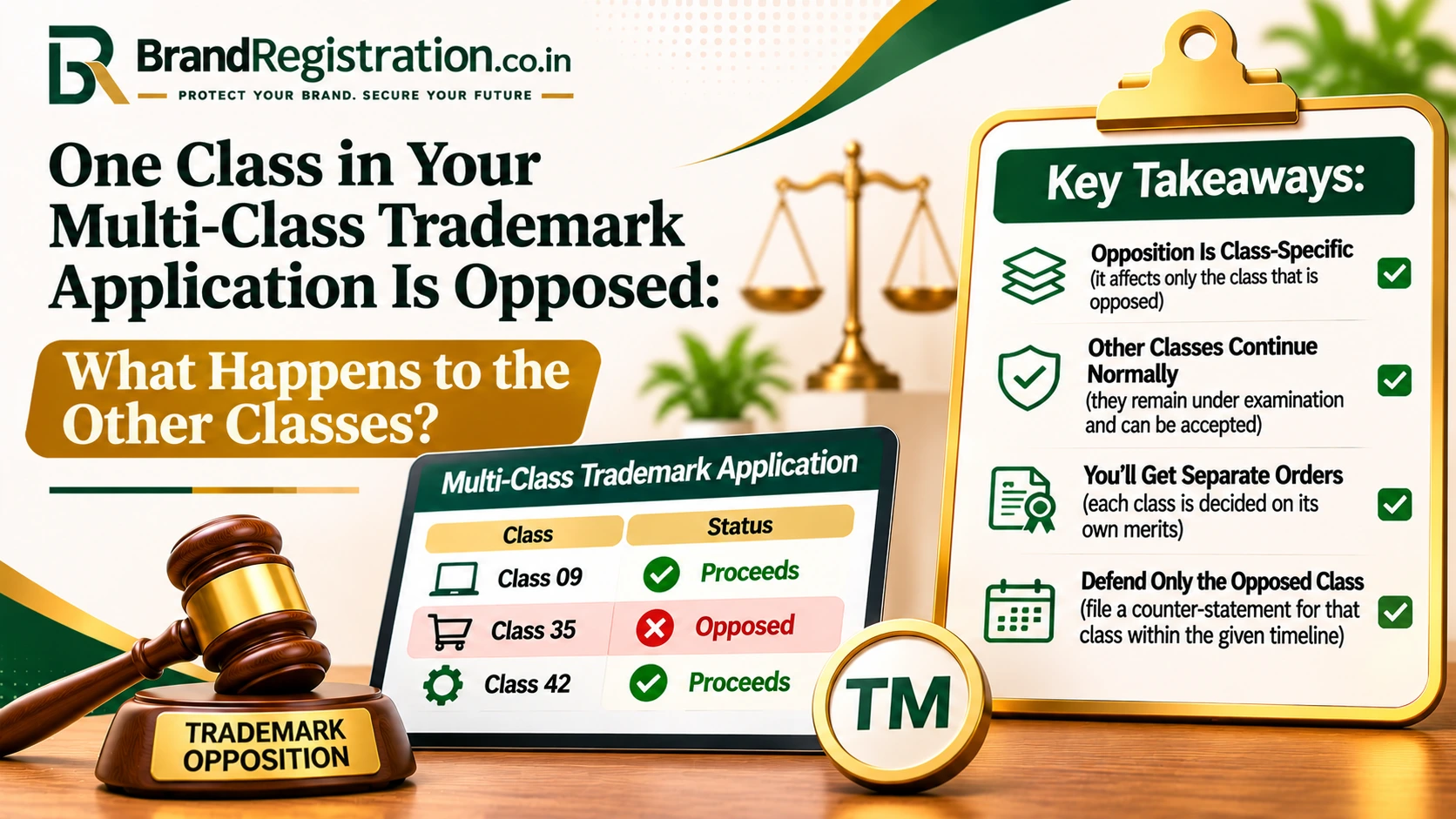
Table of Contents
An opposition aimed at one class does not automatically mean that the opponent has challenged every class in your multi-class trademark application. The other classes are not automatically registered either: their progress depends on the application record, the scope of the opposition and the Registry’s handling of the pending application.
For a multi-class trademark application opposition, the immediate job is to identify exactly what has been challenged, protect the deadline for answering it and assess whether division of the pending application is useful. Division may offer a way to separate parts of the filing, but it does not itself defeat the opposition or guarantee registration of the remaining goods and services.
1. Multi-class trademark application opposition: what changes for the other classes?
1.1 Read the scope of the dispute
A multi-class application groups goods or services under more than one trademark class. The class number is a useful organising label, but the descriptions listed under it also matter: “goods in Class X” is not a substitute for reading the actual specification in the application.
When a notice arrives, compare the opponent’s stated challenge with each class and description in the published application. A trademark opposition in one class may be described as a partial trademark opposition, but a short status label alone will not necessarily tell you which goods or services the opponent has challenged or what relief is sought.
Keep two questions separate. First, what does the opponent say should be refused? Second, what is the current procedural position of the other parts of the application? The answer to the first question comes from the opposition papers; the answer to the second also depends on the Registry record and any other unresolved issues.
1.2 Understand the procedural options
The Trade Marks Act, 1999 contains the opposition framework in Section 21 and a provision concerning correction and division of an application in Section 22. The Trade Marks Rules, 2017 include Rule 42 on notice of opposition and Rule 108 on division. These provisions are relevant reference points, but the papers and Registry record determine how to apply them to a particular filing.
A trademark divisional application is a proposed way of separating an existing application into distinct parts. In this situation, the business reason for considering it is straightforward: the applicant may want the part affected by the dispute to be handled separately from goods or services that are not challenged.
Neither a split nor the absence of an opposition to a particular description is a registration certificate. Other examination, administrative or procedural matters may still affect an unopposed part. Conversely, a dispute over one part should not be casually described to a lender, licensee or customer as proof that the whole brand has been refused.
A status entry is a useful prompt to investigate, not a complete account of the case. Use the underlying notice, journal details and application history to establish what has happened before telling your team which part of the portfolio is at risk.
2. Who should consider dividing the application?
2.1 Qualifying conditions
Division is a question about an existing application, not a way to add a new product line to an already filed specification. Start with the application’s current stage and the exact coverage already on record. The proposed division must be assessed against the applicable law and current Registry procedure.
Identify the pending application and the classes and descriptions it actually covers.
Determine which part of that coverage is challenged and whether any other issue affects the remainder.
Establish that the person giving instructions is the applicant or someone authorised to act for the applicant.
Consider whether the proposed separation can be expressed clearly without changing the mark or adding coverage.
Check the current official requirements for the proposed division before committing to a filing.
These checks are about the existing filing. If the business has since started offering something outside its original descriptions, a proposed split should not be treated as a shortcut to coverage for that new offering. Assess any new filing separately.
2.2 Business checks before choosing
Ask which descriptions matter to revenue now and which support a future launch. A business may be willing to spend more to move a core service towards registration, while allowing a peripheral category to follow the pace of the dispute. Another business may prefer to keep its resources focused on defending its principal product.
Consider the switching cost too. Separate records can make it easier to track different outcomes, but they also create more items to manage in budgets, portfolios and later correspondence. The benefit is strongest when the separation solves an identifiable business problem, rather than merely making the file look tidier.
Hypothetical: A studio applies for its brand across services used for client work and a separate merchandise category. An opponent challenges only the merchandise coverage. If the client-services coverage is central to a pending licensing deal, the studio has a concrete reason to explore whether that coverage can move separately; it still needs a strategy for the merchandise dispute.
3. Documents to prepare and what each one does
The following are preparation records, not a claim that every item must be uploaded with every request. The required attachments and format depend on the action being taken and the current Registry instructions.
3.1 Application and opposition records
Application record: Keep the application number, applicant details, mark, filing information, class numbers and full goods or services descriptions. This establishes the coverage being assessed.
Journal publication record: Save the relevant publication details and a copy of the published entry. These help identify the application as advertised and connect it to the opposition.
Notice of opposition and accompanying papers: Retain the complete notice and any material served with it. These show the opponent’s identity, the grounds raised and the scope of the challenge.
Service and correspondence record: Keep the communication through which the notice was served, along with subsequent Registry communications. This supports deadline management and provides a history of instructions or directions.
Proposed allocation: Prepare a working list showing which existing descriptions the applicant wants in each proposed part. Its purpose is to make the request intelligible; it is not, by itself, proof that the Registry will accept the proposed split.
3.2 Authority and evidence
Applicant identification and authority: Keep the applicant’s correct legal name and details available. If an agent is acting, retain the authorisation and representation records required for that role.
Earlier filings and correspondence: Gather relevant examination communications, responses and earlier proceedings involving the same mark. They may explain the history of the specification and positions already taken.
Use records: If relevant to the defence, organise dated material showing how the mark has been used, such as invoices, packaging, promotional material or website records. Do not assume that collecting material is the same as submitting evidence in the required manner.
Business records supporting instructions: Internal product lists, licensing plans and launch schedules can help the applicant decide which descriptions matter most. These are planning aids, not necessarily Registry attachments.
Keep source files legible and retain originals or reliable copies. For any actual submission, follow the current official instructions on document type, signatures, authorisation and upload requirements rather than assuming that a working spreadsheet or an email attachment is a formal filing.
4. How to move the matter forward
4.1 Preparation
Run the opposition response and the division assessment as parallel workstreams. Appoint one person to own the deadline calendar and another, if useful, to map the commercial coverage. They may be the same person, but the two tasks should remain visible.
Section 21 provides for the applicant’s counterstatement after service of the notice of opposition. The consequences of missing the applicable deadline can be serious. Calculate the deadline from the actual service and applicable law; do not wait for a division decision before addressing the response.
4.2 Submission
Review the opposition papers and decide the position to be taken on the challenged coverage.
Prepare the response through the applicable official procedure.
Decide whether to request division and define the intended allocation of existing goods or services.
Use the current IP India Trade Marks e-filing facility and the official instructions applicable to that request.
Submit the relevant filings through the appropriate channel, pay the applicable official charges and retain the acknowledgements and payment records.
After submission, track the opposition and the proposed division separately.
Record any Registry communication, serial number or updated status associated with each part.
Form TM-M is commonly identified with requests concerning division, but the supplied evidence does not establish the current form selection, attachments or fee for this particular request. Use the official IP India instructions for the live filing rather than treating a general form name as a complete procedure.
4.3 After submission
An acknowledgement shows that a transaction was submitted; it is not the same as an order allowing division or a registration certificate. Read subsequent communications for the Registry’s decision, any requirement for clarification and the way the application records have been identified.
If separate records are created, maintain a cross-reference to the original application and map each record to its actual goods or services. That lets the business answer a practical question later: which record should be cited for the product or service involved in a licence, enforcement issue or commercial agreement?
5. Government fees and professional costs
The amount to budget has more than one component. A quote for handling a division may not include the separate work of preparing a counterstatement, reviewing evidence or attending a hearing. Ask for the scope in writing before comparing prices.
Cost component | What to establish |
|---|---|
Government charge for the proposed request | The current official fee, the filing channel and the unit on which the fee is charged. |
Government charges for other proceedings | Whether a separate official payment applies to any other step actually required in the case. |
Professional preparation and filing | Whether the quote covers review, drafting, submission, correspondence and the initial follow-up. |
Later professional work | How evidence, hearings, amendments, negotiations and additional Registry responses will be billed. |
A useful budget formula is: applicable government charges plus agreed professional charges plus an allowance for later work that cannot yet be priced. Ask whether taxes and out-of-pocket expenses are included in the professional quote, and whether any unused advance is refundable.
Figures sometimes quoted online for trademark divisional application fees cannot be treated as current official fees on the evidence supplied here. The official Trade Marks fee schedule and live filing instructions should be the basis for the government-fee component; a service provider’s quote is a separate commercial charge.
For comparison, ask each provider to price the same deliverables. One quote may look lower because it covers a filing transaction only, while another includes analysis of the opposition and proposed allocation. Neither scope is inherently wrong, but the distinction affects the total you may pay.
6. How long could each track take?
6.1 Milestones rather than a promised completion date
There are two different kinds of time to plan for: a deadline imposed on the applicant and the time the Registry or parties take to complete later stages. The first needs a calendar entry; the second is a range of uncertainty that affects business planning.
Service of the opposition starts the need to calculate the response deadline.
Acknowledgement of a submission is an administrative milestone, not final approval.
A proposed division may require Registry review or further communication.
The contested coverage can remain in opposition proceedings after a division request.
Any registration date depends on the relevant part completing its applicable requirements.
Duration can vary with the scope of the dispute, the parties’ filings, Registry workload and whether further directions or a hearing are needed. The supplied material does not establish a current official processing benchmark for a division request, so a reliable number of weeks or months cannot be promised here.
For an upcoming launch or transaction, work backwards from the business date and identify what evidence of status the other party actually needs. A counterparty may accept a pending application for one purpose and require a registration certificate for another. Build that distinction into the deal timetable instead of assuming that a submission will be approved by a particular date.
Review the matter at sensible intervals and whenever a new communication arrives. A status change should trigger review of the underlying document and an update to the internal calendar, not an assumption that every issue has been resolved.
7. Mistakes that can undermine the strategy
Treating a class heading as the whole claim. The opponent may identify particular descriptions or request relief whose scope needs careful reading. Compare the notice with the complete specification and record any ambiguity for the response.
Letting the division decision consume the response window. A pending request does not make the opposition disappear. Assign the response its own owner and deadline, even if the division analysis is still underway.
Assuming the unopposed part is already registered. A pending or submitted request is not a certificate. Use accurate status descriptions in contracts and marketing until the Registry record establishes the outcome.
Using a proposed split to introduce new coverage. Prepare the allocation from the existing specification. If the business needs protection outside it, assess that need separately rather than silently inserting new descriptions.
Losing the link between records. If the Registry creates separate records, an internal tracker that lists only the original number can cause later correspondence to be overlooked. Cross-reference each record, its scope and its responsible contact.
Budgeting only for the first filing. A fee for a request may leave the opposition response and later work outside the engagement. Obtain a written scope and set aside a contingency for genuinely possible further work.
Relying on a dashboard label as the complete history. A label can be useful but may omit the detail needed to act. Read the notice, orders and correspondence before deciding what the label means for a particular class.
If an instruction or status appears inconsistent with the documents, resolve the discrepancy through the relevant Registry record or correspondence rather than submitting an allocation based on guesswork.
8. What to manage after registration
When a registration certificate is issued, read the owner, mark and goods or services on that certificate. The certificate is evidence of the registration recorded there; it should not be treated as proof that a different, still-pending part has also been registered.
Save the certificate and connect it to the original application and any related records in the portfolio register.
Record the registered descriptions and keep them distinct from any coverage still under opposition.
Enter the applicable renewal information from the official record into a reminder system, with an owner responsible for action.
Maintain current contact and representation details for correspondence.
Monitor relevant marketplace use and new filings, and preserve records of the business’s own use of the mark.
Under Section 25 of the Trade Marks Act, registration is subject to renewal. A portfolio with more than one relevant record needs a reliable way to identify which registration is due for attention and who is responsible. A calendar alone is less useful if the underlying owner and contact details are out of date.
Use the registered symbol only where the mark is registered and the representation is accurate. Registration for specified goods or services should not be advertised as a certificate covering every activity of the business. Continue managing any unresolved opposition as a separate matter.
Businesses often use “brand registration” to mean trademark protection for a name or logo. A company name and a brand name can differ, but incorporation of a company does not by itself establish trademark registration for its brand. For a new business name, identify the owner, mark and relevant goods or services, search for potentially conflicting marks, and then consider an application through the IP India system.
A show-cause hearing is generally concerned with objections raised during examination; an opposition involves a challenge by another party after publication. Both can affect an application, but the papers, issues and response strategy differ. Brand Registration’s Trademark Registration service is relevant if the business needs help organising its wider protection strategy alongside a pending dispute.
9. Choose your next three actions
Protect the response position: retrieve the complete notice and service record, assign an owner and calculate the applicable deadline. If the response period is close or the grounds are difficult, prioritise assistance with the opposition.
Make a coverage decision: mark the descriptions needed for current revenue, near-term deals and future plans. If unchallenged coverage has a time-sensitive commercial use, assess a division request; if the disputed coverage is the core business, budget for its defence as well.
Prepare to file and track: assemble the records, obtain an itemised cost scope and use the current official instructions for the relevant submission. Keep a separate tracker for each proceeding and any resulting application record.
Before filing, use the current IP India instructions and fee schedule to establish the form, attachments, charges and procedural requirements for your particular request. Begin the process online via the official government portal, or engage Brand Registration for end-to-end assistance
Frequently Asked Questions
Does opposition in one class automatically defeat the other classes?
No. Read the notice to establish what the opponent has challenged. The other classes are not automatically registered either; their progress depends on the application record and the applicable Registry procedure.
Does a divisional request end the opposition?
No. Division concerns the separation of an application. The opposition still requires a response and any further action applicable to the contested coverage.
What records should I collect before deciding whether to divide?
Collect the application and published specification, the complete opposition notice, service communications and relevant Registry correspondence. A working list of the existing goods and services proposed for each part can help assess the split.
How much does a trademark divisional request cost?
The budget can include an official charge and separate professional charges. The current official fee depends on the applicable schedule and filing requirements; obtain an itemised professional quote covering the work you actually need.
Can I wait to respond while a division request is considered?
Do not assume that a division request suspends the opposition response requirement. Calculate and manage the applicable deadline separately from the proposed division.
Does a certificate for some goods or services protect every class originally applied for?
Do not assume that it does. Read the mark, owner and goods or services recorded on the certificate and track any still-pending coverage separately.
Is a show-cause hearing the same as an opposition hearing?
They address different situations. A show-cause hearing generally concerns examination objections, while an opposition concerns a challenge by another party after publication.
Can a company name and brand name be different?
Yes. A business can use a brand name that differs from its company name. Company incorporation alone does not establish trademark registration for that brand.